Episode 8: It’s an Empty Chair

Emotional Incest and the Work-Life Balance


Emotional Incest

I think we all shiver at the would of incest. We cannot wrap our brains around it. However, we may find that we actually engage in incest without being aware. Emotional incest can be just as damaging as sexual incest. Usually the results on a childโ€™s mental health are similarly damaging, but to a lesser degree.ย Emotional incest is an unhealthy emotional attachment that blurs boundaries in a way that is psychologically inappropriate. This occurs when a parent treats their child like a partner, depending on them for emotional support. This can result in a childโ€™s inability to maintain appropriate boundaries, develop an eating disorder, begin to self harm, have relationship dissatisfaction, sexual intimacy issues, and substance abuse. Unfortunately, these issues are not immediately apparent and will usually start to manifest in adulthood.ย 

Examples of Emotional Incest:

  1. Asking your child for advice about adult issues. This can include spousal difficulties, sexual feelings, problems not directly involved with the child, basically topics that are a better fit for speaking to an adult about. 
  2. Inviting children into the problems of adult relationships can definitely blur boundaries. A parent should not have to rely on children to help them through their turmoil. When an adult asks a child for advice, they are subtly positioning the children in this role of responsibility.
  3. Parents can encourage or lead the child to consistently praise their effort or personality. This can occur either privately or in public. This is when the parentsโ€™ need to feel important takes over the spotlight by showing the child’s adoration for the parent. This forces the childโ€™s visibility to the shadows making the parents esteem or narcissism the most important. 
  4. Parents often will be best friends with their child, and this also blurs the boundaries. This leads to difficulties with discipline, expectations and personal responsibility. Additionally, when a child is put in the role of a confidante when they are not capable or ready to handle adult relationships. The child is forced to set aside their social and psychological world for the parents sake. 
  5. Putting the child in a role of therapist who navigates through the emotional crisis robs them of their own relationships and learning age appropriate socialization. The child may find themselves taking care of others’ emotional needs rather than their own. This will lead to an adult child having difficulty maintaining a romantic relationship because their need for crisis overrules the need for solidity.
  6. Putting a child in the middle of arguments during separation or divorce absolutely can be emotional incest. 
  7. The parent feels jealous when the child develops relationships with others. This can cause the child to feel guilty about external relationships and avoid building friendships or romantic relationships.

When Emotional Incest Ocurs:

This often occurs when the parent is lonely, such as divorced or having marriage difficulty, there may be a broken family dynamic where infidelity, mental health conditions or addictions are present.  This is a difficult concept to pinpoint and thus is often not reported. A child can actually enjoy some of the feelings because they feel important or special for being chosen as the confidante. Often feeling more mature, helpful or even powerful. 

It is important to keep in mind that a child is neglected when this occurs. The child is likely not given the discipline, structure or guidance as a child. There are imperative skills to learn to use in adulthood.

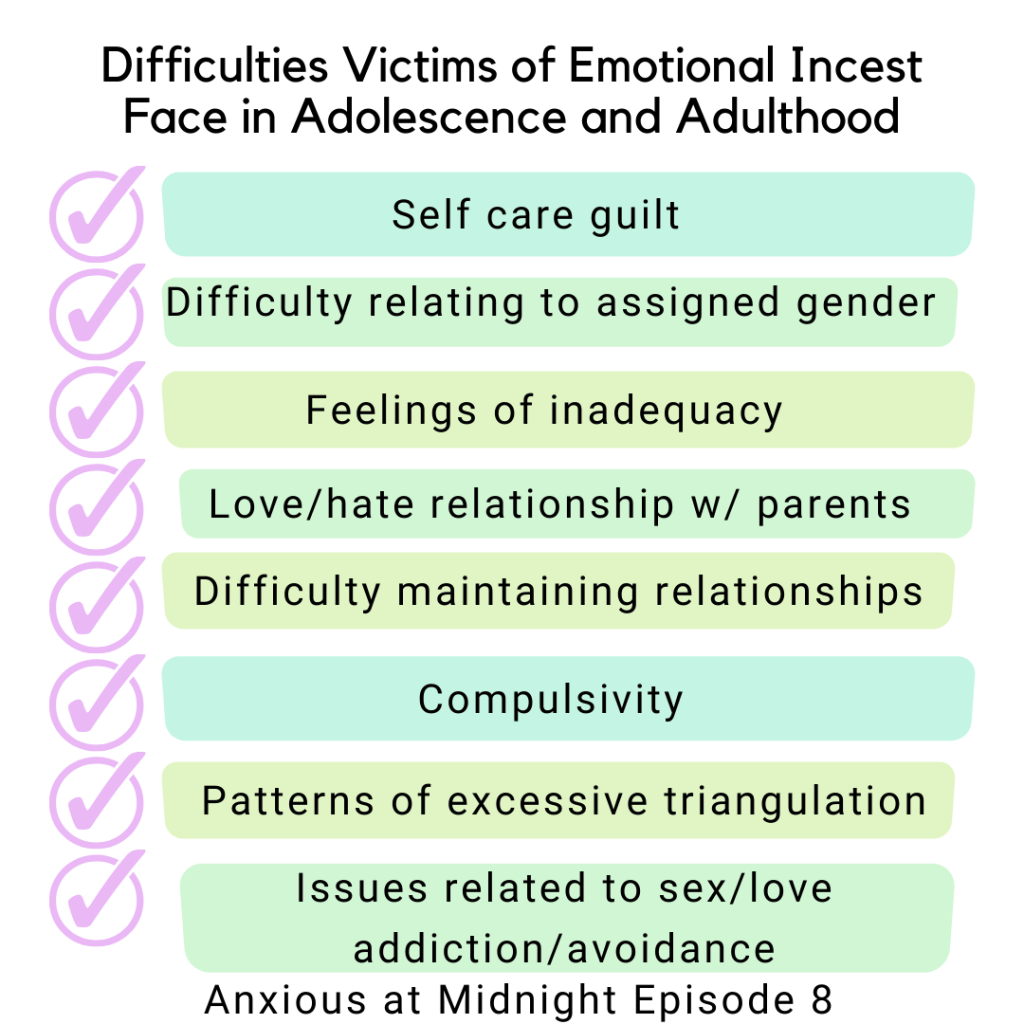
Through adolescence and adulthood, the individual can face the following difficulties:

  • Guilty about practicing self care, especially an unrealistic sense of obligation to that parent
  • Difficulties relating to sexual identity or gender
  • Feelings of inadequacy
  • Love/hate relationship with their parents
  • Difficulty maintaining relationship due to abuse individuals idealization and devaluation of others and an inappropriate expectations placed on their partners
  • Compulsivity that may include sex, substances, alcohol, work and food
  • Patterns of excessive triangulation (such as indirect communication) in work, family or romantic relationships
  • Issues related to sex addiction, avoidance or love addiction/avoidance.
There are also effect on the family as a whole there are five models:

  • The invasive parent who is enmeshed with a child who is supposed to meet their needs not being met in an adult relationship. 
  • The chosen child is the enmeshed child and often treated as all good and favored, their needs to develop as an individual, make mistakes and learn, receive structure and discipline are neglected. These children can often be scapegoats. Where the children are not only used for emotional support but for the release of anger and tension as well. 
  • The left out spouse is the spouse of the invasive parent that is shut out of the exclusive parent child bond, this may turn into a workaholism, alcohol, affairs or other unhealthy coping mechanisms. 
  • The left out children are the non favored children who may be neglected or receive less of the family’s resources and often bond with the left out spouse. 
  • The spouse of the chosen child will later grow up and marry and their spouse may find themselves in a disturbing triangle. 

Healing:

  • Therapist who specializes in childhood abuse, enmeshment or codependency.ย 
  • Self help meeting where an individual can gain an understanding that they are a survivor of emotional incest. These meetings will usually follow the 12-step model which is especially helpful.ย 
  • Journaling is particularly helpful because writing about the issues helps an individual process their thoughts.ย 
  • Psychoeducation is highly important because an individual who educates themselves and increases their understanding. Increasing their understanding can help an individual heal.ย 
  • One article suggested an intensive out-patient program where they specialize in emotional incest recovery.ย 
    • Identify family of origin and particular family dynamics involvedย 
    • Recognize any patterns of emotional incest between caregivers and abused individual
    • Learn to set boundaries with that parent. In the case of a deceased caregiver work with a therapist who can help facilitate empty chair work or another experientially based modality for grief and loss
    • Acknowledge any feelings of abandonment as a result of the emotional incest
    • Work toward individuation and separation by learning to reparent the self (Inner child work)
The Work-Life Balance

My whole life it seems like I was always doing too much of one thing and not enough of another thing. Last year it was not managing my mental and physical health and only working on my school work. This summer it has been working on all my neglected hobbies and avoiding job applications. 
I think we all get carried away with one thing or another and we let our priorities go. But the consequences can be detrimental if we do not find the perfect work-life balance.  If you think you are spending too much time in one area of your life, ask yourself these questions:

  1. Are you working too much?
    1. You feel guilty turning off phones when not at work
    2. Coworkers are upset that you do not answer their messages right away
    3. You say โ€œmy job is killing meโ€
  2. Are you studying too much?
    1. Not sleeping well
    2. Not eating right
    3. Classmates are the only people you see
    4. You stop responding to messages
    5. Not retaining information
  3. Are you cleaning too much?
    1. You are late because of your cleaning habits
    2. You are infringing on other peopleโ€™s lives
  4. Are you spending too much time with your partner?
    1. Friend throwing shade
    2. You donโ€™t like the way your partner breathes
    3. Falling behind
    4. You donโ€™t know what to do when they arenโ€™t around
    5. Bored in relationship
    6. Resent your partner
  5. Are you spending too much time with your hobbies?
    1. It hurts your finances
    2. Affects sleep, work, home, relationships

If you answered yes to any of the questions above, here are some tips and tricks:

  1. If you are working too much
    1. Turn off notifications for work
    2. Speak with coworkers about not messaging after certain hours
    3. Also, try using an app like RescueTime, which clocks your daily habits, analyzes your productivity, and alerts you when you spend too much time on an activity
    4. Possible career move
    5. Get hobbies
  2. If it sounds like you are studying too much
    1. Schedule a study schedule
    2. Make time for hobbies
    3. Make time for meals
    4. Make time for friends
  3. If you are cleaning too much
    1. Allow only an hour of cleaning a day
    2. Let the small details go
  4. If you spend too much time with your partner
    1. Create me time
    2. Get out of the house
  5. If you spend too much time with hobbies?
    1. Set a hobby budget

Overall tips

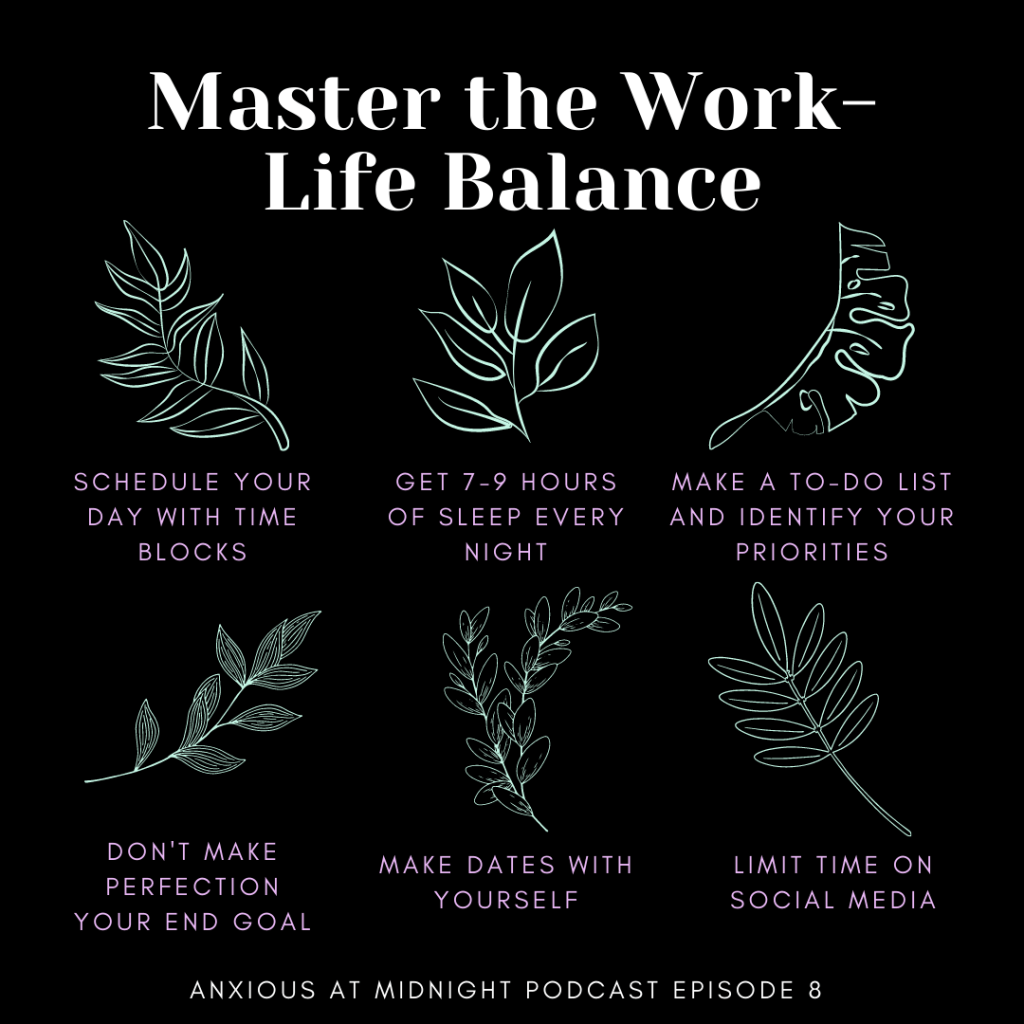
  • Set a schedule
    • Schedule time blocks
  • Get your priorities right
    • Set limits (work, hobbies, chores)
  • Sleep
  • Make a list
  • Take a break
  • Limit time on social media
  • Donโ€™t make perfection your end goal
  • Learn something new
    • Avoid going crazy
  • Make dates with friends, family
  • Make dates with yourself
  • Examine your life regularly

Disclaimer

This podcast includes explicit content, we discuss triggering material and are not mental health professionals. If you need immediate help please call the suicide hotline at 800-273-8255.

Sources

https://psychcentral.com/blog/emotional-incest-when-is-close-too-close#4

https://www.goodtherapy.org/blog/emotional-covert-incest-when-parents-make-their-kids-partners-0914165

https://www.bpdfamily.com/content/was-part-your-childhood-deprived-emotional-incest

https://fherehab.com/learning/emotional-incest-what-is-it

https://www.fuzia.com/blog/details/8-ways-to-balance-work-and-personal-hobby

https://www.dailyinfographic.com/the-consequences-of-spending-too-much-time-at-work

https://zenhabits.net/how-to-find-that-elusive-balance-between-work-and-life/

https://blog.studentlifenetwork.com/2019/05/27/hobbies-balancing-work-life/

https://www.academiccourses.com/article/Five-Signs-That-You%E2%80%99re-Studying-Too-Much/

https://www.chegg.com/play/life-hacks/23-signs-youve-been-studying-too-much-and-need-a-break/

https://moneyning.com/budgeting/are-you-spending-too-much-on-your-hobbies/
Episode 7: As soon as this is over, it’s on.

Family Scapegoat and New Therapist


Family Scapegoat

For those of you who are unfamiliar with Family Scapegoat abuseโ€ฆ let me enlighten you. Toxic families usually have children who are blamed for all the problems in the dysfunctional household. The family punching bag who is picked on and made fun of. 

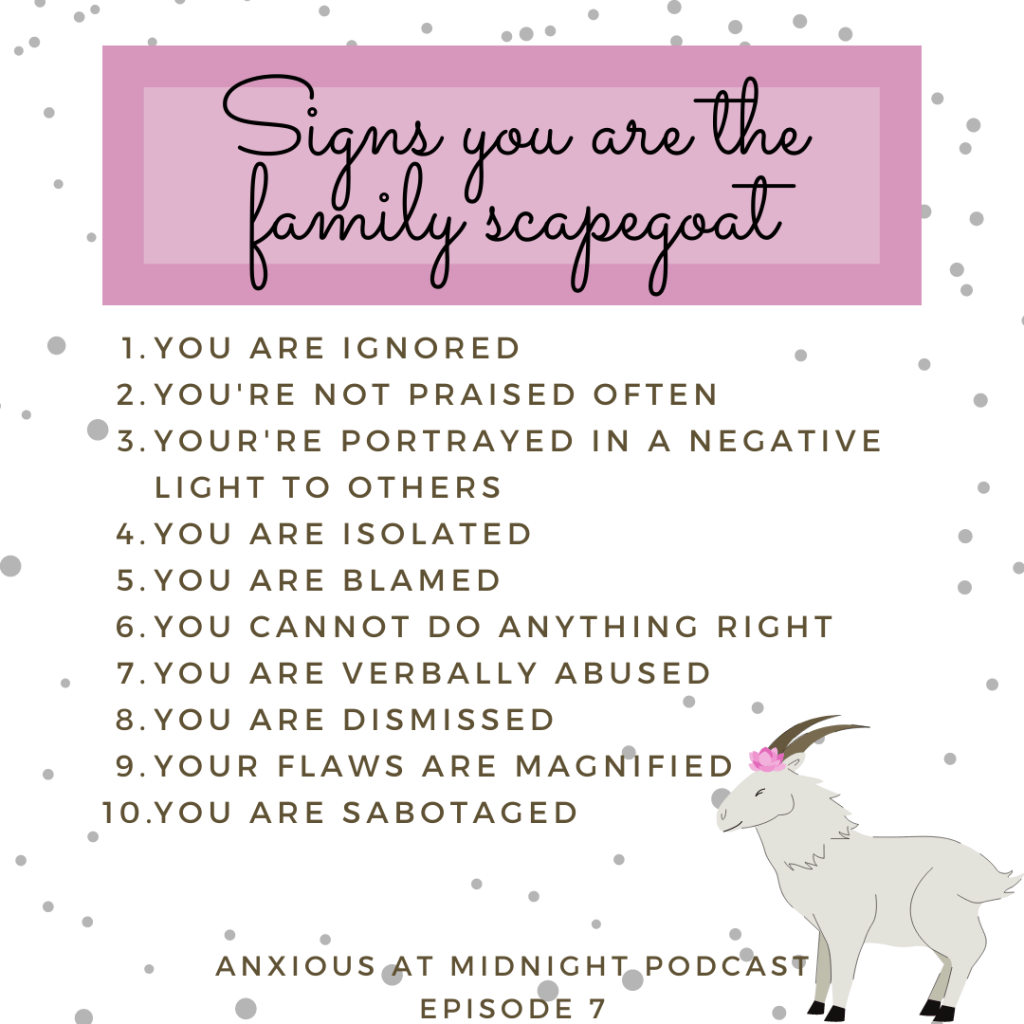
Are you a scapegoat? If you are a scapegoat, you will have experienced some or all of the following:

You are ignored

No one wants to hear what you have to say because you are usually the most sensitive and frequently the whistleblower on obvious dysfunction. This leads to them being uncomfortable and they prefer to freeze you out. When speaking the truth you find your family trying to discredit you. They go as far as humiliation because they are unable to accept the truth. 

You’re not praised often

Healthy families are proud of other achievements. Not if you’re the scapegoat. Often they are dismissed or belittled. Children will often grow up to believe their families narratives and end up with a lifetime of low self esteem and crippling self doubt. 

You are portrayed in a negative light to others

Your character is publicly attacked every chance they get. Your family wants to convince others of your worthlessness so they do not have to take responsibility for the dysfunction or for them to be โ€œon your sideโ€. People usually only hear about your flaws and failures, not your positive qualities or success. 

You are isolated from others

They do not want you to receive support or encouragement from outside the family. They try to isolate you from friends and loved ones. This can include separating you emotionally by causing conflict or spreading rumors. They might attack the character of your friends to make it less likely that you will seek their support. Powerlessness is the end goal. 

The flaws of others are projected onto you (accusations)

Blamed for the behavior your abuser is actively engaged in. Mom has a bad day, and she forgets to take your sibling to the doctor. Instead of admitting forgetfulness, she tells you that you are lazy, disorganized and do not remember to do anything. 

You are blamed

You cannot do anything right.

You are verbally abused

Often wearing every negative adjective (lazy, stupid, irresponsible, etc.)

You are labeled

The scapegoat has trained the entire family how to treat you. When labeled the base one, you become fair game for everyone else. 

You are dismissed

Rarely rewarded for good behavior, usually betlitted and ignored. 

Your flaws and mistakes are magnified 

I told you soโ€ฆ your family is happy to share anything negative about you. When you fulfil the negative actions they assign to you they are affirmed. 

You are sabotaged

Normal developmental milestones may be ignored in your household. Often you may feel defeated. 

โ€œThe Lureโ€

Oddly, as bad as they claim you were, if you manage to escape their control, they will likely attempt to lure you back in with emotional manipulation. They might start with a guilt-inducing angry rant before evolving into a softer, more supportive approach, playing on your desire for their approval. This might be followed by a fictional recounting of history โ€” when they were loving, supportive and always well-intended. They will try to convince you and everyone else that their unfair treatment of you was a figment of your imagination. But you know better…you were there.

โ€œScript flipโ€

If these attempts don’t reel you in, prepare for the level 10, code red, frantic fire drill as they embark upon a rage induced campaign of unprecedented petty proportions. Watch as they go hard to convince everyone in their realm of influence that youโ€™re crazy. Stand back as they frantically use every tool in their kit to assassinate your character. Marvel as they cast themselves as victim and magically spin you as the troubled one. Because they are incapable of owning their own guilt, anger and pain, they have to manipulate and project their insecurities outside of themselves. This is precisely why they needed a scapegoat to begin with.

Overview:

It is very common for scapegoats to be blamed for the behavior of other family members. Sometimes it is even blatantly obvious that it is ridiculous to see, yet the scapegoater sees nothing wrong with it. Your family will make it clear what flaws you have in your character. Keep in mind that this process is largely an unconscious process where the family displaces their own collective psychological difficulties and complexities onto a specific family member. This does not mean that the rejectings, humiliating, blaming and shaming are unconscious, the projection process fueling the scapegoating of the family member is unconsciously fueled by multigenerational trauma. 

The impact on a child can be detrimental to their mental health and emotional well being for a lifetime. When a child is a scapegoat, their inherent worth, goodness and loveableness are ignored. Insults, bullying, neglect and abuse are deemed appropriate for them instead. 

How they are chosen:

No real formula to how they are chosen, it is completely random. Lame ass reasons like birth order, gender, looks, or intellect. Favorites or golden children may be the only boy.. The youngest – like this bitch ass hoe sitting with me recording this. 

Scapegoating is rooted in dysfunction, a child who may be sensitive, inquisitive, attractive or smart may seem like a threat and scapegoated by a parent who lacks these qualities. A Narcissistic parent might prefer a child that brings the most glory, and scapegoat the shithead who does not boast the family image. 

This can sometimes be because children resemble the parents’ ex partner, maybe they are step kids. Regardless IT IS NEVER THE CHILDโ€™S FAULT. It is never about the childโ€™s inherent worth as a human being. 

This role can be rotated. This indicates just how troubled parents are. They may have been raised in dysfunctional families where the children were scapegoats and others were golden children. Maybe they have a personality disorder such as narcissistic personality disorder or borderline disorder. This can lead them to idealize or devalue people, often thinking in black and white. 

Effects:

As anyone could guess, scapegoating your child seriously fucks up their shit. Basically you are depriving the child from love and being singled out as the โ€œbad oneโ€. Often overlooking their positive qualities. I can tell you from personal fucking experience that this sets your child up for a lifetime of emotional and psycological distress. Often that child will enter into abusive relationships and working environments. This is because they will grow up thinking that it is normal for people to abuse them. 

Gaslightingโ€ฆ That shit is fucked up first of all. Gaslighting makes it challenging for the abused to set boundaries and recognize when someone is crossing their boundaries. A child who is scapegoated has been told their whole lives that they are too sensitive or that there was no abuse. Often the parents will say that the parents are all treated the same while showing blatant favoritism and mentally or physically harming the scapegoated child. 

These children internalize the harmful messages which result in self – sabotage or self harm. This ranges from neglecting self-care and not doing well in school to physically harming themselves or engaging in risky behavior. This often leads the child to earning their title as the scapegoat. They may excel in other areas of life. They will still be drawn to the abusive behavior that harms their self care. 

Being a scapegoat lonely and heartbreaking for a child to experience. Scapegoats are often driven to leave the family because of the maltreatment they receive, while the golden child remains enmeshed in the harmful family system. This is because this abusive treatment can give the child the ability to see a toxic family for what it is. This results in distancing himself and getting help to recover. Usually, they are the ones who chose to end the generation cycle of abuse. They vow to never treat their children or to always be supportive for their children. 

As an adult, the child will bear the burden of recovering from a childhood full of bullying, put downs, unequal treatment and abuse. They did not grow up in a safe stable home where they had the unconditional love of their parents (or caregivers). These children are usually singled out and pitted against their siblings and other family members.

Perhaps the most troubling effect is that family scapegoating abuse leads to complex trauma. A victim may have generalized anxiety disorder, major depressive disorder, dissociative identity order with psychosis, ADHD, OCD, Agoraphobia, BPD or an attachment disorder. Even worse, they may have complex post traumatic stress disorder. Rejecting, shaming and non-nurturing, harmful and abusive environments has contributed to the C-PTSD – aka complete trauma disorder. 

Healing:

This can take a lifetime. It is important to consult someone who specializes in dysfunctional families and childhood trauma. You can also read books and do your own research. Prioritize your mental health. If you cannot go no-contact, you can go low contact. People will try to convince you to remain in contact with your toxic family. Some people do not understand the psychological toll that this takes on a person. A lot of times the parents’ public persona is very convincing. You know what is best for you, you were there for the abuse, not them. Low contact occurs when you put firm boundaries of the types of contact they are willing to take. Maybe only through text, email or a phone call. Some maybe limit the in person meetings to holidays, weddings, graduations, etc. It is up to you. Find a support systemโ€ฆ first. 

Remember that as hurtful and damaging as this is, your perpetrator was only acting out of their dysfunction. They too were likely tormented by their own feelings of inadequacy. 

How To Break Free, Heal and Recover From Scapegoating

Understand that what you have come to believe about yourself as familyโ€™s Scapegoat โ€“ i.e. that you are bad, weird, inadequate or defective โ€“ is not the truth.  In fact itโ€™s likely a lie that was created to prevent family members from acknowledging their own troubles, thereby avoiding taking responsibility for both their behavior and the need to change.

Locate and trust your โ€˜Inner Owlโ€™ โ€“ that wise part of you that knows you have been mistreated and will no longer willingly allow this abuse from others or yourself.

Recognize that feelings of shame, guilt and self blame belong to the perpetrators, not you as a target.  You are simply a dumping ground for their bad feelings.  To change this, you need to start standing up to the notion that you are at fault.  You will likely have to begin with yourself, learning to question and reject seeing yourself as โ€˜badโ€™.

Get to know your true self.  Identify exceptions to the negative stereotype you have been saddled with.  In other words, pinpoint what is good, likeable or at least adequate about you โ€“ your character, values, actions, etc.  Write down your good traits โ€“ you will need to be reminded of this alternate universe, which is the truth about you, especially if you start to fall back into the habit of feeling bad about yourself again. Understand that getting better โ€“ and feeling better โ€“ is a learning curve, and you may slip a few times before you gain solid footing

Figure out what you might be doing โ€“ consciously or unconsciously โ€“ that gives scapegoaters the idea that itโ€™s OK to abuse you.  Determine how to change any behavior that draws you into the Victim role.

Stop trying to win the favor of abusive and uncaring family members, co-workers or โ€˜friendsโ€™.  Anyone who engages in this type of inappropriate behavior has personality problems, especially a parent who did not love their child.

Donโ€™t expect abusive family members to apologize or make amends.  They will likely blame you more if you attempt to hold them accountable.

Start asserting your right to be treated respectfully with family and other people who try and abuse you.  E.G., โ€œThe way you just spoke to me now is not acceptable, and I never want to be talked to like that againโ€, or โ€œIf you want to have a relationship with me, you will stop the angry outbursts, name calling, accusations, etc.โ€  Know that you may not be heard or respected by aggressive or disturbed people.  The point is that you hear and respect yourself!  Donโ€™t do this until you are ready to follow through with your commitment to yourself.

Accept that you may never have a healthy relationship with your scapegoater(s).  This may involve limited or no contact with those who are determined to continue to abuse you.  You may experience feelings of grief.  Work through the painful feelings, and get support if needed.  This pain is much less harmful than continuing to allow yourself to be abused by anyone. 

Get in the habit of treating yourself with kindness, caring, compassion, appreciation and acceptance.  Practice viewing yourself as a person of worth and lovability. This will likely feel weird at first as it is unfamiliar.  But even though it is unfamiliar, treating yourself in a loving manner is never wrong.

Understand that it will take time to learn how to love and appreciate yourself.  You have been trained to be overly self critical and may believe you are defective.  Be patient as this false image gradually crumbles.  Get counseling to help you overcome this painful legacy, and find your true self โ€“ the strong, valuable person you are meant to be.

 Practice what you preach with othersโ€ฆ Break the cycle

Important note:

But reallyโ€ฆ if you find yourself treating your child in any of the ways listed above. Please seek help. This is an irrevocable action that can devastate a childโ€™s life. I am just starting to realize this behavior and I have a long way to go to heal. It has been a painful process. It takes so much energy and hard work. Please be the one who stops the generational abuse. 

And if you are the victim. Know, you are not alone in this. There is nothing wrong with you.

New Therapist

Sometimes we need a new therapist. This can be for several reasons:

  • Initially not the right fit
  • Can’t help you with a specific problem in this stage of your life
  • Sometimes you just need change
  • Unsatisfied

Whatever it is, do not give up looking. Therapy can lead to big results. Lisa Olvera, a licensed marriage and family therapist, says that โ€œResearch shows that the biggest predictor of success in therapy is the quality of the relationship between therapist and client, Because of this, finding someone you connect with is SO key! Being vulnerable is difficult enough, and itโ€™s made harder when you are trying to force a therapeutic relationship that just isnโ€™t the right fit.” So keep looking till you find the perfect fit.

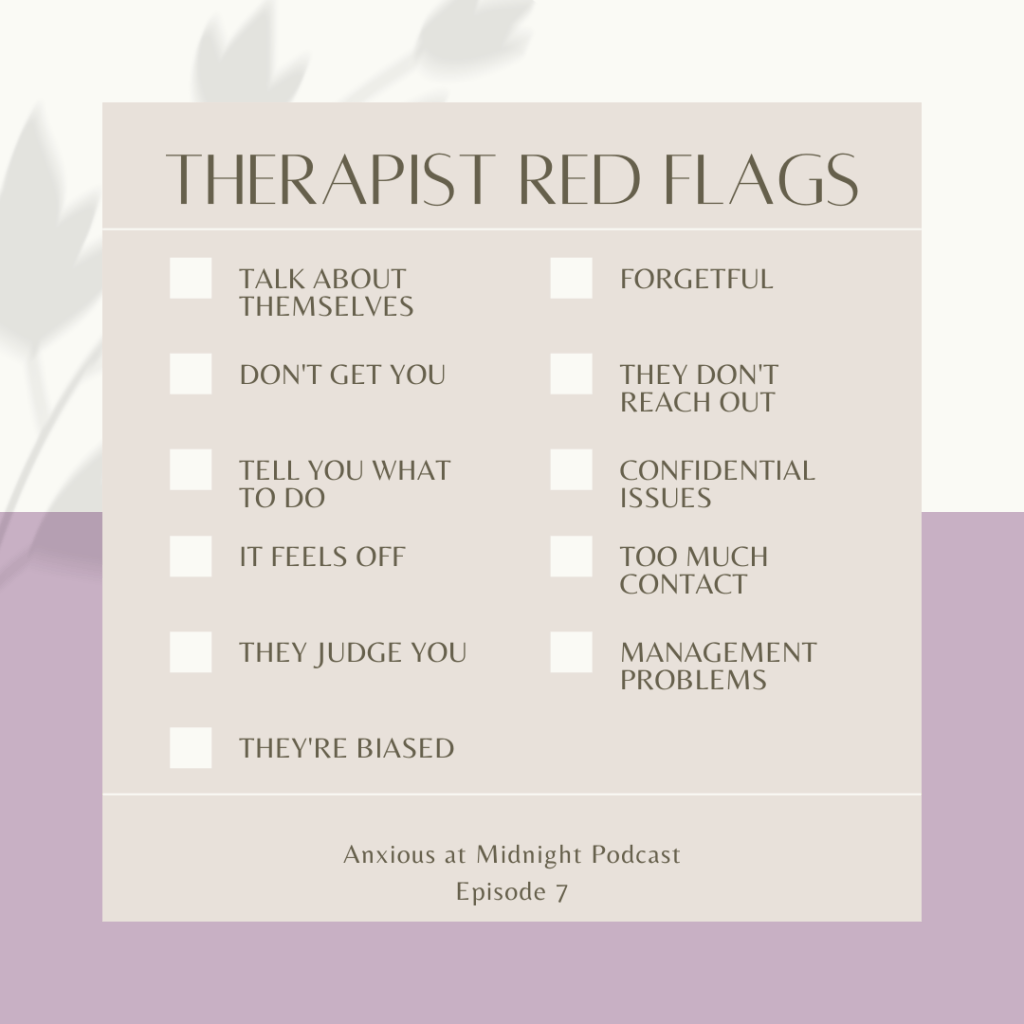
Here are some big red flags to watch for as you look for a new therapist:

  1. They talk about themselves
  2. They donโ€™t get you
  3. They tell you what to do
  4. It feels off
  5. They judge you
  6. Theyโ€™re biased
  7. They forget things you tell them
  8. They donโ€™t say anything if you miss an appointment
  9. Confidentiality Problems
  10. Too much contact 
  11. Management problems

If you are still with your current therapist and wondering if it is time to move on, here are some questions to ask yourself:

Are you comfortable with your new therapist?

Sometimes you just do not click with a person and when it is your therapist that you do not click with, it can be very difficult to share things with them. Remember, at first it may be uncomfortable so do not give up yet unless you see the red flags above

Are you making progress?

Therapy is a very long process in some cases and that progress can be difficult to measure. Here are some questions to assess that progress:

  • Does your therapist have plans or goals?
  • Does your therapist ask about your progress?
  • Does your therapist use evidence-based interventions?

Do they provide an empathetic environment?

You should be able to share things without a cold response.

Does your therapist become emotionally reactive when discussing challenging issues?

Your therapist should be able to remain calm no matter how difficult the topic is.

Do you feel like your therapist is listening to you?

Should show signs of active listening.

Do you feel your treatment is progressing?

Progress and change time but you and your therapist should have discussed a treatment plan and regularly address it to ensure you are moving in the right direction.

Does your therapist push their values onto you?

You are your own person and therapy should not be used to change your personality.

Does your therapist encourage you to blame your problems on other people?

Therapists should be encouraging you to look at your role in the problems you are experiencing where appropriate to ensure your growth.

Do you feel like the advice you are receiving is right for you?

Is your therapist reliable?

Does your therapist have the right experience to treat you?

Most therapists specialize in specific areas of psychology which can further help you if you know the root of your problems. 

Is it you?

Maybe you are resisting change and further discussions with your therapist may help you in your decision. 

If you do decide to move on from your therapist here are some tips:

  • Discuss it with your therapist if you are comfortable
    • They may be able to guide you and make suggestions
  • Use the experience to determine what you are looking for
  • Arrange record transfers

Disclaimer

This podcast includes explicit content, we discuss triggering material and are not mental health professionals. If you need immediate help please call the suicide hotline at 800-273-8255.

Sources

https://www.verywellmind.com/what-does-it-mean-to-be-the-family-scapegoat-5187038

https://www.regain.us/advice/family/are-you-the-family-scapegoat-signs-you-may-be-and-what-you-can-do-about-it/

https://www.pacesconnection.com/blog/5-critical-things-to-know-about-family-scapegoating-abuse-fsa

https://blavity.com/12-things-the-family-scapegoat-will-know-to-be-true/12-things-the-family-scapegoat-will-know-to-be-true?category1=editorial-desk&category2=relationships

https://glynissherwood.com/12-steps-for-family-scapegoat-healing/

https://www.bustle.com/p/8-signs-its-time-to-get-a-new-therapist-9839352

https://www.talkspace.com/blog/switch-therapists-how-to/

https://www.psy-ed.com/wpblog/change-therapist/

Episode 6: Low Pain Tolerance

Highly Sensitive Personality and Sitting Down and Getting it Done


Highly Sensitive Person

Fionna tends to react as a 30 on a scale of one to ten for certain things. She has wondered why she has such a large reaction. Weโ€™re talking about her husband eating a cookie she saved for herself and she is ready for a divorce. Through the research, Fionna was able to identify that she is a highly sensitive person. 

People who are highly sensitive have increased and deeper central nervous system sensitivity to physical, emotional or social stimuli. This is also known as sensory processing sensitivity. This is a fucking personality trait. Which results in increased responsiveness to positive and negative influences. Concept began in the mid 1990s with psychologists Elaine Aron and Arthur Aron. They created a personality questionnaire to help people identify themselves, it is called the Arons Highly Sensitive Persons scale. About 20% of the population have this personality trait. A highly sensitive person shares similarities with introversion but it is not the exact same. 

The following are signs that you may be a highly sensitive person:

  • People tell you’re too sensitive, shouldn’t think so much, etc.
  • People strike you as too insensitive
  • You may:
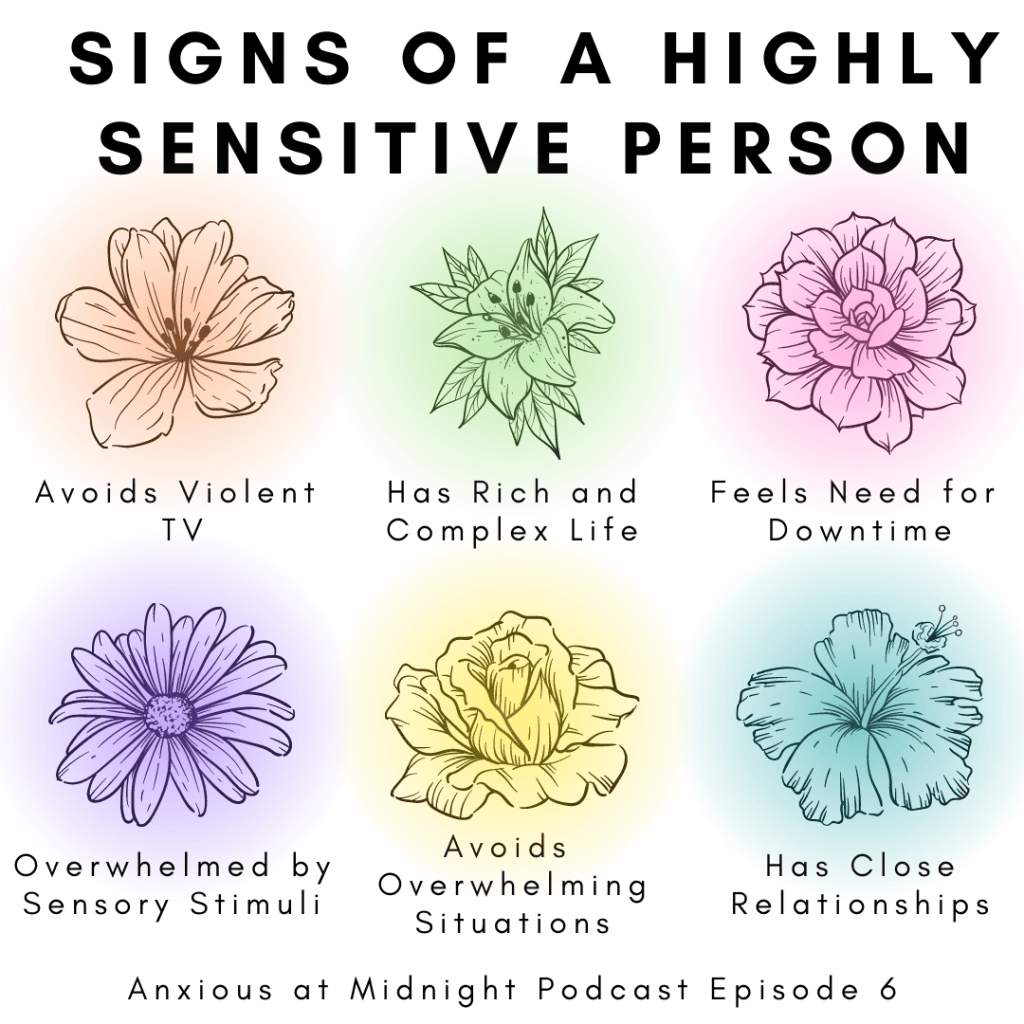
    • Avoiding violent movies or TV shows because they feel too intense and leave you feeling unsettled
    • Being deeply moved by beauty, either expressed in art, nature, or the human spirit, or sometimes even a good commercial
    • Being overwhelmed by sensory stimuli like noisy crowds, bright lights, or uncomfortable clothing
    • Feeling a need for downtime (not just a preference), especially when you have hectic days; needing to retreat to a dark, quiet room
    • Having a rich and complex inner life, complete with deep thoughts and strong feelings that go with it

Being a highly sensitive person has upsides and downsides. It is possible to be easily offended, possible to overreact to daily stressors or relationship issues, this is especially true if you become emotionally aggressive as a response. This doesn’t mean that you imagine negative motives when not there, it is more that you perceive them more easily. Maybe you are more affected by deeply negative experiences. 

Additionally, you may find:

  • You might avoid situations that leave you feeling overwhelmed. Highly sensitive people may be more affected by certain situations such as tension, violence, and conflict, which may lead them to avoid things that make them feel uncomfortable.
  • You might be highly touched by beauty or emotionality. Highly sensitive people tend to feel deeply moved by the beauty they see around them. They may cry while watching particularly heartwarming videos and can really empathize with the feelings of others, both negative and positive.
  • You may have close relationships with others. They care deeply about their friends and tend to form deep bonds with the right people.
  • You may be grateful for the life you have. Highly sensitive people appreciate a fine wine, a good meal, or a beautiful song on a level that most people can’t access. They may feel more existential angst, but they also may feel more gratitude for what they have in life, knowing that it is possibly fleeting and nothing is certain.

The pitfalls of being a highly sensitive person can be a little rough. First, hectic schedules can make an HSP feel overwhelmed and rattled if they have a short amount of time to do things. 

The expectations of others also affects them. HSPs often pick up on the needs and feelings of others, hate letting people down, it is hard to say no, feel crushed by demands of others because they feel their disappointment if they do say no. Refer back to episode four for expectations of other people, this can also affect an HSP. HSP can be stressed by conflict, more aware of trouble bewingin, things feel off, this also can lead to misinterpretation of unrelated things as signs of anger, etc. Social comparison occurs often for an HSP. They may feel negative feelings of another person plus their own. They experience feelings stronger, are aware of the possibility of improvement and get upset when potentially good outcomes turn into a negative outcome. They usually become more upset when they realize the relationship is over because they leave thinking it could be resolved. The things that we tolerate day to day can be energy drainers. They can create stress and are not necessary. Distractions are more frustrating such as a foul smell, cluttered space, etc. An HSP also tends to get Hangry. An HSP is their own worst critic, they ruminate and have severe self doubt. Usually embarrassing mistakes cause them to be more embarrassed than average and they tend to never forget about it. They don’t like to be watched or evaluated, and mess up when doing so.. They are usually perfectionists, but may also be aware of the way that this stress is not inevitable and how it affects them. 

Some tips to send you off with:

  1. Add positivity to your schedule to help with stress
  2. Avoid stressors like slasher movies, people who drain your positive energy, make heavy demands on you or make you feel bad about yourself
  3. Learn to say no to overwhelming demand and feel ok with those boundaries. 
  4. Set up a safe place so that you can have a soothing environment.

Sitting Down and Getting it Done

A challenge everyone experiences throughout their life is struggling to sit down and get something done. It could be bills, making appointments, applying to jobs, studying, completing assignments and maybe even doing the things you love. We are not alone in feeling this whether it happens to you every once in a while or on a daily basis. 

Causes

Understanding the root causes of what is preventing you from getting work done can be one way to overcome that hurdle. Here are some causes.

Distractions

Distractions can be anything but are most commonly your electronics. But it can also be your thoughts or your kids. 

Our Mindset

By nature we often put something off until we are in what we perceive as danger especially if that work is difficult or boring.

Sleep Deprivation

When your body did not get enough sleep the night before, it can negatively impact your motivation and kill your vigilance which is your ability to maintain concentrated attention over long periods of time. 

False Sense of Security 

Sometimes we put things off with approaching deadlines because we feel there is no danger. We are in no position to lose our jobs, our housing, our grades etc. Another example is feeling you have a lot more time than you actually do.

Planning Fallacy

No matter how hard we try, we will always overestimate how much can be done in a short period of time and underestimate how much can be done in a long period of time

No Motivation or Focus

Motivation and focus can take us a long way and if this is your weakness, once you understand how to boost your lack of motivation and focus, you will overcome the hurdle.

Fear of Failure

This is probably the one I relate to the most. No matter what I do, I feel like I will be judged harshly or fail at the assignment. This results in me putting things off. 

The Impossible task

If you have ADHD, experienced severe depression and anxiety, you have probably experienced the impossible task. No matter how important or demanding the task is, you feel paralyzed and find difficulty overcoming the task. I have found that in some cases, facing this fact makes it easier to fight my psychology and overcome the task.

Effects

Of course, being unable to meet deadlines and get things done can make us face dire consequences. In the short term it can break trust, change people’s perception of you and over the long time, it can result in anxiety, depression, burn out and low self esteem. And over time this can snowball into losing your job, dropping out of school, losing your home or worse. But not all hope is lost. Here are some tips to follow.

Solutions

Stick to a Bedtime

Making sure you get enough can make sure your brain and body are ready for anything. A bedtime will make your brain get into a natural rhythm and may even gift you more productivity.

Make a To Do List

Before you get started on your day, decide on what is most important by making a list of your priorities. Decide on how much time you have throughout the day and be selective on where you will be putting your time and energy throughout the day.

Pomodoro technique

This will not be the first time I talk about this because it is my absolute favirtue technique when I am struggling with a large to-do list. Basically I remove all distractions from my workspace, clear off my desk, turn up the lights, close the door and set the timer. I just start with whatever is first on the list. I work for 25 minutes straight and take a break for 5 and then repeat 4 more times before my longer 30 minute break. This has worked wonders for me in a pinch. 

Set Time Up For Yourself 

It is recommended to spend time on yourself first but making sure you do some self care will go a long way for your brain. I like to take care of my brain in the midst of my day.

Remind Yourself of Your Values

When you look at your long term goals it can motivate you a lot more because right now the small step to where you are going doesn{t mean a lot but it can motivate you to pick up the pace.

Reward Yourself

No matter what the outcome is, make sure you set up some type of reward for yourself to make the work worth it. 

Set Deadlines

Some people do not have deadlines given to them and they have to make their own. If you fall into this category, it is of the utmost importance that you set up your deadlines and pen them into your calendar so you cannot change them or slack off. 

It Does Not Have to Be Perfect

Seriously. Let it go and get it done. You can perfect it later, you were going to anyway. 

Baby Steps

It is so important that you break up any big project or even small task into baby steps to make it much more doable. That way, as you track your progress, you will feel more accomplished. In general, the mountain won{t look so big anymore.

Get Help

I cannot tell you how much I wish I got in the better habit of asking for help earlier on. One of the best lessons you can learn in life is to be able to ask for help no matter who it is. It could be your mentor, a stranger, a peer or even a subordinate. Building a support system will go a long way.

Get professional Help

If you are suffering from ADHD, depression, anxiety, etc. or an unknown mental health struggle, seek out a therapist and psychiatrist. Remember that you are not to blame. This is not your character, it is a symptom. Release yourself from all guilt and expectations. 


Disclaimer

This podcast includes explicit content, we discuss triggering material and are not mental health professionals. If you need immediate help please call the suicide hotline at 800-273-8255.

Sources

https://hsperson.com

https://www.verywellmind.com/highly-sensitive-persons-traits-that-create-more-stress-4126393

https://www.lifehack.org/articles/productivity/7-reasons-you-wont-start-studying-until-its-too-late-and-what-about.html

https://www.fastcompany.com/3025757/why-you-can-never-finish-anything-and-how-to-finally-change-it#:~:text=One%20of%20the%20reasons%20people,fear%20of%20being%20harshly%20evaluated.

https://lifehacker.com/how-to-do-the-impossible-task-when-youre-depressed-1828942797

https://www.drsarahedwards.com/youre-not-lazy-you-could-be-stuck-on-the-impossible-task/

Episode 5: A Savage Bitch

Self Awareness Results and Returning from Vacation


Self Awareness Results

What is self awareness?

A Psychological state where oneself becomes the focus of attention. It is the ability to identify and understand their feelings, thoughts, and behaviors. Basically it is when you start paying attention and becoming aware of what you are doing. The first component of oneโ€™s self concept. Simply put:

โ€œWoven into the fabric of who you are and it emerges at different points depending on the situation and your personality.โ€

Now it may sound simple, butโ€ฆ this shit is not easy. In fact, most of us lack self awareness. Mostly because it is hard for humans to be self aware. Our brain functions are out of date and survival functions are rooted in ancient times. This leads to being caught up in defensive emotions and biases that prevent self awareness. We actually think we are self aware.. But in reality only 10-15% of people truly are. 

Why is self awareness important?

When you have self awareness, you start to reap certain benefits:

  • Give you a better understanding of what you want and/or need
  • Increase your chances of getting what you want and/or need
  • Improve your decision making
  • Help you manage your emotions
  • Lead to healthier reactions to external factors
  • Boost your productivity and success
  • Enhance your ability to make positive change
  • Bolster your self-esteem
  • Strengthen your relationships
  • Allows you to understand what you can control, and can’t. 

But.. there is a secret element: vulnerability. It is important to remember that being vulnerable is not being weak, exclusive or dark. It can help you uncover what you are looking for. Be honest when looking for how self aware you are. 

4 Proven Benefits of Self-Awareness

Many benefits to practicing self-awareness:

  • It can make us more proactive, boost our acceptance, and encourage positive self-development (Sutton, 2016).
  • Self-awareness allows us to see things from the perspective of others, practice self-control, work creatively and productively, and experience pride in ourselves and our work as well as general self-esteem (Silvia & Oโ€™Brien, 2004).
  • It leads to better decision making (Ridley, Schutz, Glanz, & Weinstein, 1992).
  • It can make us better at our jobs, better communicators in the workplace, and enhance our self-confidence and job-related wellbeing (Sutton, Williams, & Allinson, 2015).

Not an exhaustive list.

 Self-awareness has the potential to enhance virtually every experience you have, as itโ€™s a tool and a practice that can be used anywhere, anytime, to ground yourself in the moment, realistically evaluate yourself and the situation, and help you make good choices.

Cultivate

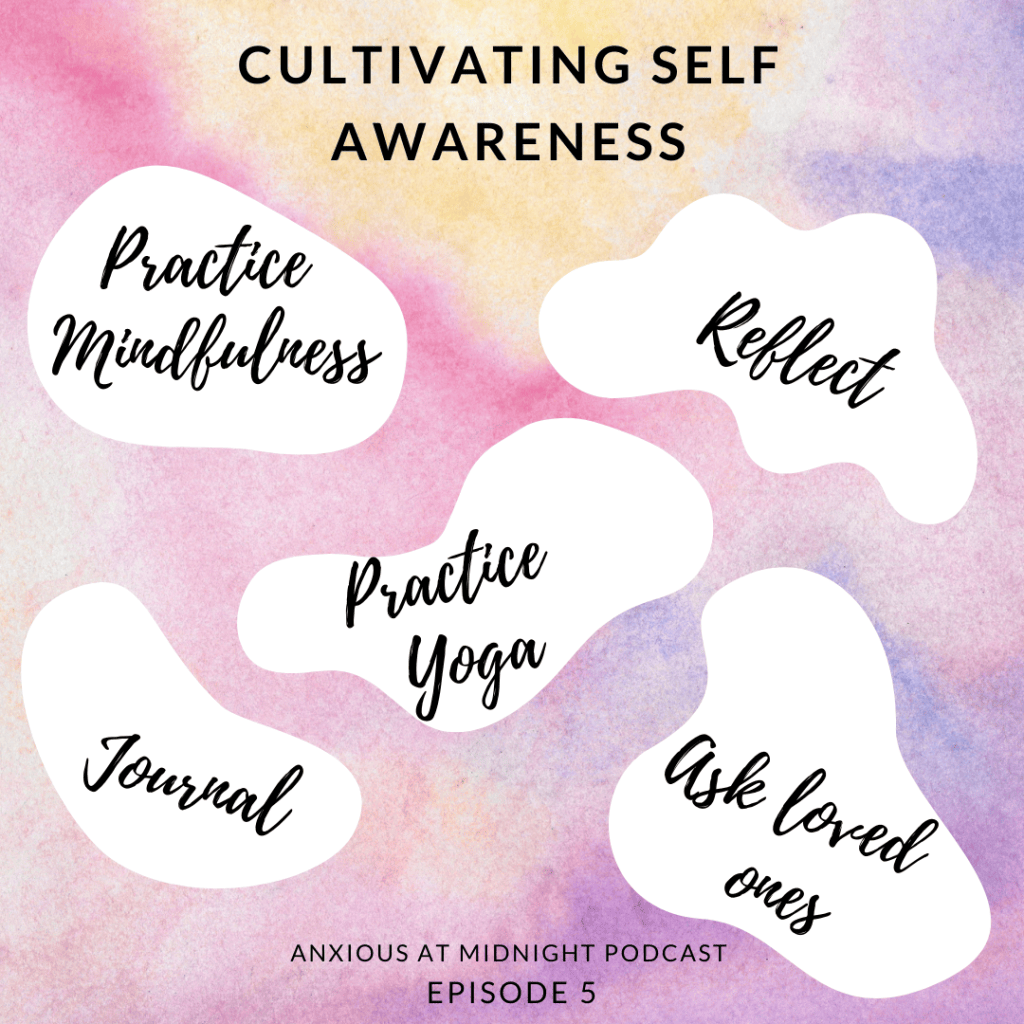
1. Practice mindfulness and meditation – helps you gain greater awareness of your emotions

Mindfulness is when you are present in the moment and paying attention to yourself and your surroundings. Similarly, meditation is the practice of focusing your attention on one thing (breath, mantra) while the rest drifts away. Both lead to awareness of your internal state and your reactions to things. Mindfulness and meditation can help identify your thoughts and feelings and keep from getting so caught up in them that you lose your hold on yourself. Doing so can help lead you to decisions despite us being told to shut off our feelings and rely solely on rational thoughts – this could leave us to live up to anotherโ€™s ideas. Our feelings are our internal advocates.

2. Practice yoga

Again, yoga is a physical practice, but itโ€™s just as much a mental practice. Body is stretching and bending and flexing, your mind is learning discipline, self-acceptance, and awareness. You become more aware of your body and all the feelings that manifest, and you become more aware of your mind and the thoughts that crop up.

3. Make time to reflect – this can help you keep track of your feelings

Reflecting can be done in multiple ways. The important thing is to go over your thoughts, feelings, and behaviors to see where you met your standards, where you failed them, and where you could improve. Reflect on your standards themselves to see if they are good ones for you to hold yourself to. You can try writing in a journal, talking out loud, or simply sitting quietly and thinking, whatever helps you to reflect on yourself. You will begin to notice patterns and trends. It will help you define your purpose, values, motivations and anything that might be holding you back. Next you can try to start tracking your energy, you can then identify your peak performance period. This will show you what motivates you and what drains you.

4. Journal

The benefit of journaling is that it allows: Identifying, clarifying, and accepting your thoughts and feelings. It helps you discover what you want, what you value, and what works for you. It can also help you find out what you donโ€™t want, what is not important to you, and what doesnโ€™t work for you. Both are equally important to learn. Whether you like to write free-flowing entries, bulleted lists, or poems, writing down your thoughts and feelings helps you to become more aware and intentional.

5. Ask the people you love

But firstโ€ฆ a warning. Do not ask the people in your life who you know are toxic or harmful. Other than thatโ€ฆ feel free to reach out to your supportive network. Itโ€™s vital to feel we know ourselves from the inside, but external feedback helps too. Ask your family and close friends about what they think about you. Have them describe you and see what rings true with you and what surprises you. Carefully consider what they say and think about it when you journal or otherwise reflect. Of course, donโ€™t take any one personโ€™s word as gospel; you need to talk to a variety of people to get a comprehensive view of yourself. And remember that at the end of the day, itโ€™s your self-beliefs and feelings that matter the most to you!


Returning from Vacation

Have you ever gotten back home after a vacation and felt completely exhausted and wondered how you would get through the upcoming work week? Well look now further! After going on a vacation and needing to come home to get shit done, I found some tips for everyone to follow.

But first and foremost, do not feel guilty about taking your vacation! You deserved every minute of it.

Before you leave 

  • Clean up your home and your work space
  • Plan an outing with friends when you come home
  • Write a to do list

When You Return 

  • Do not go back the day after you return from vacation
  • Go through emails from oldest to newest before responding
  • Get an update
  • Update your to do list
  • Bring a piece of vacation with you
  • Write thank you notes to those you traveled with 
  • Write a journal entry about your vacation
  • Unpack right away
  • Interact with others about your vacation
  • Go to work with a new set of fresh eyes
  • Take breaks through the day
  • Do not add dramatic lifestyles to your life when you return

Disclaimer

This podcast includes explicit content, we discuss triggering material and are not mental health professionals. If you need immediate help please call the suicide hotline at 800-273-8255.

Sources

https://myquestionlife.com/self-awareness-test/

https://positivepsychology.com/self-awareness-matters-how-you-can-be-more-self-aware/

https://lifeskillsthatmatter.com/self-awareness/

https://www.verywellmind.com/what-is-self-awareness-2795023

https://www.inc.com/john-discala/how-to-recover-from-post-vacation-fatigue-get-back-to-work.html

https://www.themuse.com/advice/the-8-best-things-you-can-do-for-yourself-when-you-return-from-vacation

https://www.themuse.com/advice/how-to-come-back-from-vacation-and-not-want-to-die

https://www.topresume.com/career-advice/10-tips-for-returning-from-vacation-with-minimal-stres

Episode 4: Small Enough?

Self Awareness Test and How to Avoid Naps


Self Awareness Test

Take the Self Awareness Test Here! Fionna will review your results in depth in episode 5!


How to Avoid Naps

 It feels like every week there is new data surrounding sleep and naps. If you are like me, you wonder if your long naps that last a couple of hours are good for you. It really just depends on your history with sleep, how much sleep you had last night and many other health factors. 

This episode focuses on the bad of naps since naps make myself and many other people feel very tired and groggy. One reason why people wake up groggy is because of sleep inertia. This usually occurs when your naps are longer than 20-30 minutes. Studies show that shorter naps improve your cognitive functioning and will not throw off your sleep schedule. Long naps during the day will worsen your sleep at night. But I do want to remind readers and listeners that if you have insomnia or poor sleep in general, naps of any length might worsen these problems.

Not only will long naps leave you feeling groggy and make sleeping at night difficult, it will increase your risk of heart disease and death if you nap longer than one hour when you slept more than six hours the night before. If you do sleep insufficiently the night before, it is recommended that your nap remains under 30-45 minutes. 

If that does not scare you enough, repetitive sleep deprivation will increase your risk for obesity, diabetes, high blood pressure, stroke, heart disease and mental health. Some researchers have found that naps have also led to high blood pressure, diabetes, obesity, depression and anxiety.

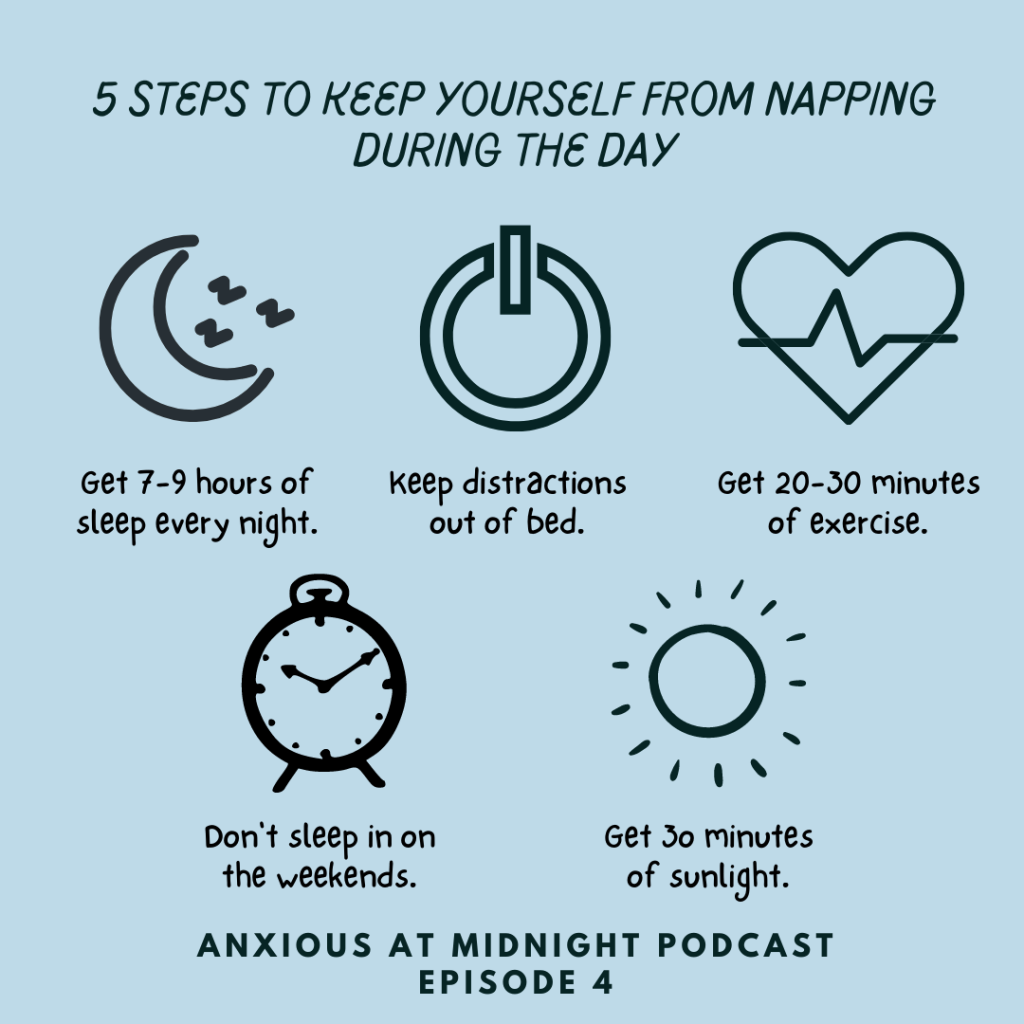
So here are some things to help you resist the urge of sleeping during the day:

  • Understand the health risks involved with long naps
  • Sleep the full 7-9 hours every night 
    • Same bed time and same wake up time
    • Avoid sleeping in, even on the weekends
  • Keep distractions out of bed (includes books)
  • Set a consistent wake up time
    • If you have insomnia, focus on the wake up time rather than a bed time
    • Gradually move up your bedtime earlier by 15 minute increments
  • Set consistent, healthy mealtimes
    • Finish meals 2-3 hours before bed time
  • Exercise (20-30 minutes a day)
  • Exposure to sunlight (30 minutes)
  • Declutter your schedule
  • Donโ€™t go to bed until you are sleepy
  • Donโ€™t nap late in the day
  • Create relaxing bedtime ritual
  • Avoid alcohol
  • See a sleep specialist

I highly recommend seeing a sleep specialist if you are having trouble with sleep and it is negatively impacting your daily life. Sleep disorders like sleep apnea can make you wake up feeling exhausted.


Disclaimer

This podcast includes explicit content, we discuss triggering material and are not mental health professionals. If you need immediate help please call the suicide hotline at 800-273-8255.

Sources

https://www.forgettingfairytales.com/how-to-stop-being-so-controlling-in-a-relationship/

https://inspiringtips.com/ways-to-stop-being-controlling-in-a-relationship/

https://lauradoyle.org/blog/how-to-stop-being-controlling-in-a-relationship/

https://betterhumans.pub/how-i-stopped-trying-to-control-my-partner-and-took-responsibility-for-my-own-happiness-da091ce799f5

https://www.mouthhealthy.org/en/az-topics/b/brushing-your-teeth

https://www.mayoclinic.org/healthy-lifestyle/adult-health/expert-answers/brushing-your-teeth/faq-20058193

https://www.healthline.com/health/when-you-dont-brush-your-teeth#timeline

https://www.hello-products.com/friendly-blog/8-tips-to-make-brushing-your-teeth-a-habit/

https://www.ncbi.nlm.nih.gov/pmc/articles/PMC4841282/

Episode 3: CPR with a Straw

Controlling Behavior in Relationships and Brushing your Teeth Daily


Improving Your Controlling Behavior in a Relationship

Fionna decided to take a look into exactly what controlling behavior looks like in a partner. Often she would find herself thinking…if my partner would just be more romantic, considerate, etc, everything would be fine. Does that sound familiar? You may want to read onโ€ฆ

โ€œInstead of taking responsibility for their own happiness, which would be empowering, codependentsโ€™ focus is external. Rather than attend to their needs directly, they try to exercise power over others and control others to make themselves feel okay on the inside. They think, โ€˜Iโ€™ll change him (or her) to do what I want, and then Iโ€™ll be happy.โ€™ This behavior is based on the erroneous belief that we can change others.โ€

Darlene Lancer

The reason:

We try to control others into meeting our own needs. This turns into a Hallmark of codependency. Basically, you can choose intimacy, or control, you just can’t have both. It is important to give up unnecessary control of things your partner does: how they drive, what they wear, what they do at work, how to load the dishes, etc. When you let go of control over these simple things, it helps you gain power in your life. Doing all the work is exhausting! Relaxing and enjoying while your partner helps is a better place to be in. 

Controlling behaviors occur when you do for other what they should do for themselves. Some example of this include:

  1. Maintaining physical health
  2. Sticking to routines
  3. Staying in touch with family and friends
  4. Financial responsibility for purchases
  5. Helping other avoid the negative consequences of their behaviors

Examples of Controlling Behaviors

  • You try to dictate what your partner does and when.
  • Or you interfere with their friendships or other relationships.
  • You seem to be isolating them from other people (sometimes unintentionally.)
  • What’s more, you seem to want them with you at all times and donโ€™t understand or respect their need for alone time.
  • Youโ€™re often quick to criticise and always want your partner to meet your standards.
  • You make acceptance / love / care / attraction conditional.
  • Sometimes you may guilt-trip your partner to get what you want.
  • You can also get angry or overreact when you donโ€™t get what you wantโ€ฆ which often results in arguments.
  • You might cross the line by invading their privacy โ€“ spying or snooping.
  • Likewise, you make plans for the two of you without even consulting them.
  • Youโ€™re always the default decision maker and definitely say you โ€˜wear the trousersโ€™ in the relationship.
  • You donโ€™t like to compromise and arenโ€™t willing to meet in the middle. In fact, you donโ€™t ever really listen to their point of view.
  • You try to dictate your partner’s future to match your own desires. (Are you seeing them for who they really are or who you want them to be?)
  • You always want to know where they are and what theyโ€™re doing and need constant disclosure.
  • Similarly, you want them to focus on you instead of others, and take it personally when theyโ€™re not.
  • Your worrying is excessive. You worry a lot when theyโ€™re doing things without you or making decisions without you.
  • And again, you then ask an excessive amount of questions.
  • You use a scorecard or hold things against them to give yourself more power. Theyโ€™ll often have to โ€˜earnโ€™ trust or other good treatment.
  • You make them feel beholden to you because you give them all you can. Itโ€™s almost like they owe you something, are unworthy or donโ€™t quite โ€˜measure up.โ€™
  • You often feel jealous, throw around accusations or get paranoid.

Okโ€ฆ take a deep breath. This is a hard realization: Just because youโ€™ve been acting in ways youโ€™re not proud of, doesnโ€™t mean youโ€™re a bad person. It is a lot more common than you think. Think about all of those Tik Tok videos where people are making fun of these controlling behaviors. 

So why do we want to control our partner?

  • Recognizing why we try to control others is a big step to change. One big reason is usually low self-esteem and losing your partner. You tend to want to hold on to them tighter to make sure that you don’t lose them. You have got to listen to this episodeโ€ฆ because right about here is when Fionna mentionsโ€ฆ her hamster and you want to hear that story. 
  • Another reason may be certainty and safety. 
  • You might also be trying to control others to fall into predictable patterns and behaviours, so that there are no unexpected surprises or deviations from what you expect. 
  • Maybe you are trying to avoid any issues or conflict so you  become overly controlling. 
  • You may have been hurt before when you trusted someone and they let you down. This can be from lying, cheating, or going behind your back. If you are worried it will happen again, you may become overly controlling. 
  • If someone has been controlled by someone else in their past or is being controlled by someone else now โ€“ sometimes they then overcompensate, to try to regain control back into their life. But, it comes at the cost of developing a healthy, meaningful relationship with their partner. Think about this: controlling behavior can lead to negative behavior in your partner, rebel against you, tempted to do what you dislike out of anger. 
  • Hard upbringing, developed controlling tendencies and anxiety about maintaining their life. A child that grows up in this situation may try to fill the gaps left by parents that couldnโ€™t fulfill their role well.

Steps to Improve your Controlling Behavior

  • Write a list of your habits
    • What do you do that seems controlling?
    • Discuss it with your partner
  • Recognize how you feel in that moment
    • When you are putting unreasonable demands on your partner, think about what you are thinking. 
  • Change your reaction
    • What can you do instead?
      • Issue: constant texting when partner is out and become angry if they donโ€™t respond
      • Plan: Create new habits to do when these things occur 
        • Write all worry out in a diary 
        • Try to write it out to process it
        • Anger management techniques
        • Anxiety as well
  • Find things to help you – distraction
    • Plan a later date, go out with friends/family, keep the phone out of reach, etc. 
  • Work on building yourself up 
  • Find helpful books, therapist, coach, etc. (or our podcastโ€ฆ)

Rememberโ€ฆ Relationships are amazing but they are not everything. You ARE STILL YOUR OWN PERSON AND SHOULD LIVE YOUR LIFE. You need to know that you will be ok without them. 

Tips to Work Through the Behavior

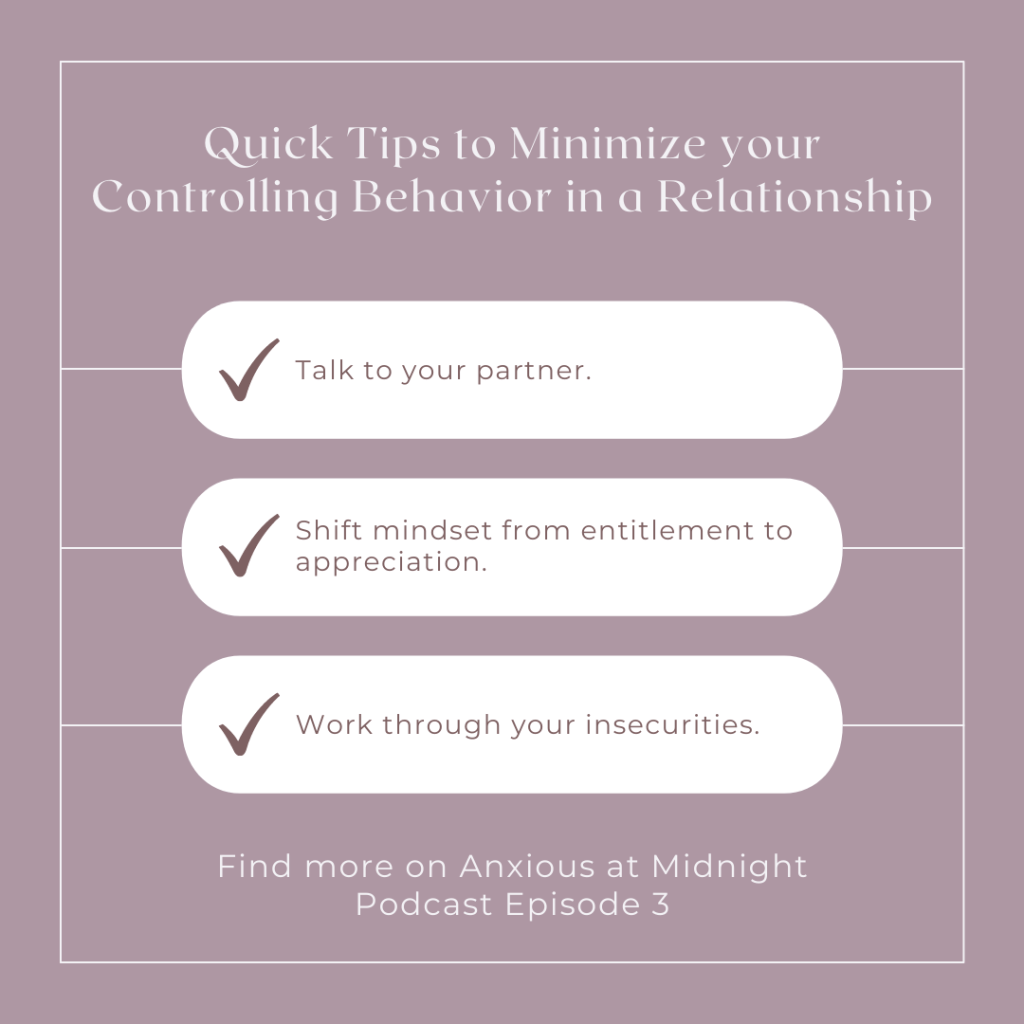
  1. Talk to partner:
    1. Work as a team, communication is key, support. 
    2. Try to put yourself in their shoes
  2. Mindset shift from entitlement to appreciation
    1. Think about your partner and how lucky you are to have them
    2. How important this relationship is 
  3. Focus on what you can give, not what you are getting
    1. Be the best partner you can be because you love them, you want them to be happy. 
    2. Don’t sabotage yourself by being excessively demanding. 
    3. You will get more back if they are happy too, significantly changing the interactions. 
  4. Remove negative thoughts
    1. Stop assuming the worst is going to happen
  5. Work through insecurities
    1. Usually caused because of our insecurities, we need to learn to value ourselves
  6. Let your guard down
    1. Constantly worrying about the thing you don’t want to happen does not keep it from happening.
  7. Learn to trust your partners decisions
    1. Do not think that your partner is not capable of making good decisions
  8. Remind yourself of why you chose to be with this person 
  9. Accept that there are things beyond your control
  10. Turn demands into questions
  11. Look at how you are communicating
    1. Questions are a great way to remove demands
    2. How you communicate will help your partner as well. 
  12. Open your mind
    1. Take things as they come
    2. It does not have to be your way or the highway
    3. Compromise, if you can’t maybe this is not the right partner
    4. It will still be ok if it doesn’t end up the way you thought. 
  13. Healthy balance in relationship
    1. Encourage your partner to do things without you and make sure you’re doing things too.
    2. Space to move and breathe will bring you closer. 
  14. Understand that it’s ok you’re different
    1. You two are not the same person – respect differences
    2. Life through your eyes will be different
    3. We all have our own thoughts, opinions, beliefs etc. 
  15. Avoid manipulation and threats to get what you want
    1. Very toxic behavior: bribes, or setting up situations exactly how you want
  16. Refocus on your own needs, desires and passions
    1. Meet your own needs
    2. Pursue your own passions
    3. Make a list of things you cannot control and then find a way to spend that energy
    4. Learn to say no

Dental Hygiene

If you struggle with your mental health, it is very likely that you also struggle with your dental health. After joining several communities which focus around mental health, I learned that I was a part of the majority who struggled with their dental hygiene. 

I always felt so embarrassed because there were days I did not have enough energy to brush my teeth. Just enough to throw on a dress and walk out the door. We have all been there and you should not feel bad. 

I am here to share some insights on the impact of poor dental hygiene and how to incorporate some dental hygiene into your life. 

Benefits of Brushing Your Teeth

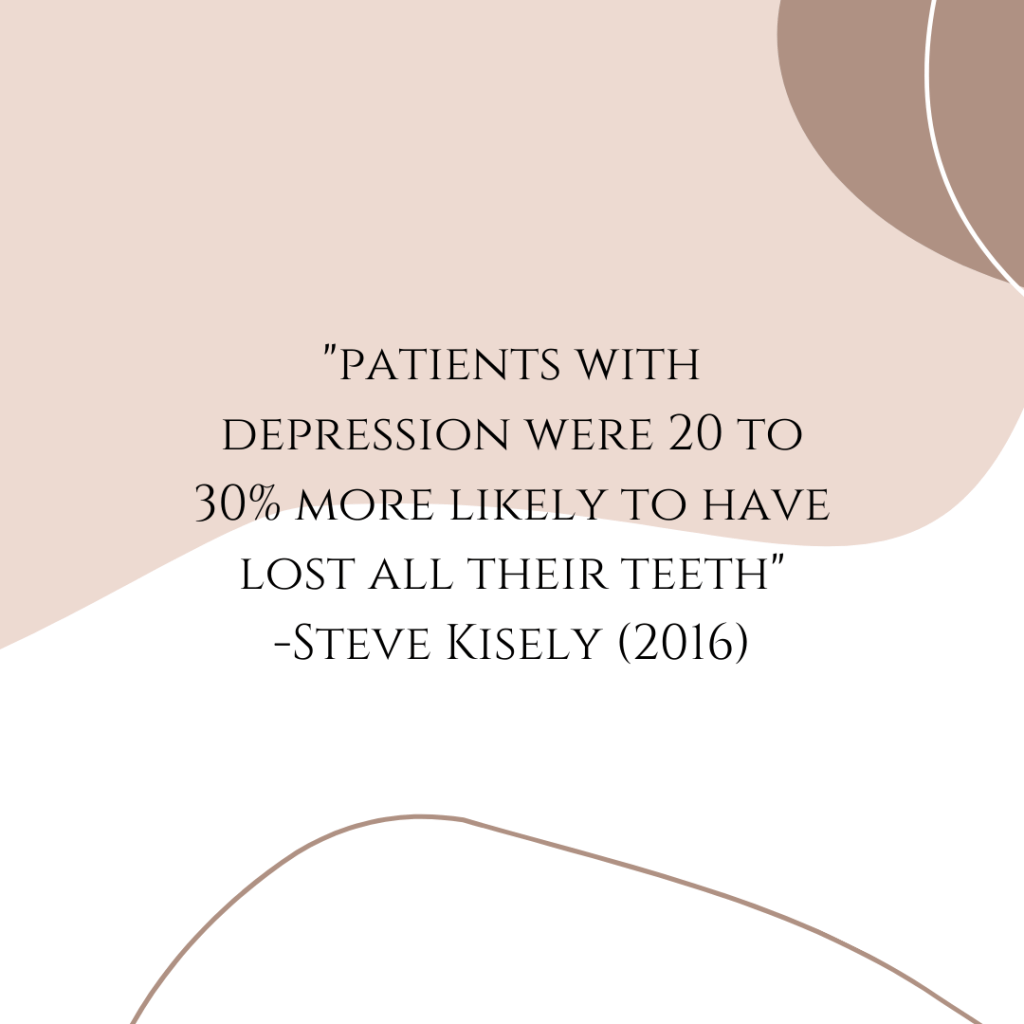
Brushing teeth will remove food and plaque which carry bacteria which can produce acid and attack your teeth enamel. Cavities will result in the breakdown of your enamel and plaque can become tartar which can build up under your gums and lead to gum disease which can snowball into severe bone infection in the teeth and cause tooth loss. 

How to Brush

Brush two times a day for 2 minutes and floss once a day. It is recommended that you go for a dental appointment every 3-6 months. Replace your toothbrush every 3-4 months. Refrain from tobacco use and brushing your teeth after eating acidic food. 

Tips

  1. Set a reminder on your phone
  2. Make a smile diary
  3. Bookend your day
  4. Put money where your mouth is
  5. Do it as a family
  6. Keep a brush in your purse or office
  7. Consider the gravity of a cavity (pain, money, time, etc.)
  8. Find fun ways to brush teeth (flavor, electronic toothbrushes, kidโ€™s brush, etc)

Tips for Those Really Struggling

If you canโ€™t brush your teeth to the full extent yet. That is okay. Here are some hacks to start:

  • Disposable Brushes
  • Baby Wipes
  • Chewable Toothpaste Tablets
  • Keep toothbrush in shower
  • Habit Tracker/Dry Erase Board
  • Floss Picks
  • Mouth Wash
  • Brush for Less Time
  • Keep in Multiple Locations
  • Waterpik Machine
  • Reward Yourself
  • Products with Xylitol
  • Drink tons of water

Disclaimer

This podcast includes explicit content, we discuss triggering material and are not mental health professionals. If you need immediate help please call the suicide hotline at 800-273-8255.

Sources

https://www.forgettingfairytales.com/how-to-stop-being-so-controlling-in-a-relationship/

https://inspiringtips.com/ways-to-stop-being-controlling-in-a-relationship/

https://lauradoyle.org/blog/how-to-stop-being-controlling-in-a-relationship/

https://betterhumans.pub/how-i-stopped-trying-to-control-my-partner-and-took-responsibility-for-my-own-happiness-da091ce799f5

https://www.mouthhealthy.org/en/az-topics/b/brushing-your-teeth

https://www.mayoclinic.org/healthy-lifestyle/adult-health/expert-answers/brushing-your-teeth/faq-20058193

https://www.healthline.com/health/when-you-dont-brush-your-teeth#timeline

https://www.hello-products.com/friendly-blog/8-tips-to-make-brushing-your-teeth-a-habit/

https://www.ncbi.nlm.nih.gov/pmc/articles/PMC4841282/

Episode 2: A Cookie on a String

Adding Walks to Your Day and Post College Depression


Ways to Get Your Ass Walking in the Morning

Fionna here. Listen, my back hurts.. Its been hurting for years. I never feel good, I am always tired, when I do feel good I want to do other thingsโ€ฆ like sit and play video games. My pain got worse when I was in a car accident in 2014โ€ฆ that was my dadโ€™s faultโ€ฆ more on that later. Over the past seven years my body has been slowly dyingโ€ฆ in a sense. I am super heavy and out of shape. I need to start walkingโ€ฆ and that is why I picked this topic. So here we go.

So my plan is to walk for 10 minutes everydayโ€ฆ I’m struggling just thinking about it. The following are tips I found to get your ass on the move. 

The bag drop method:

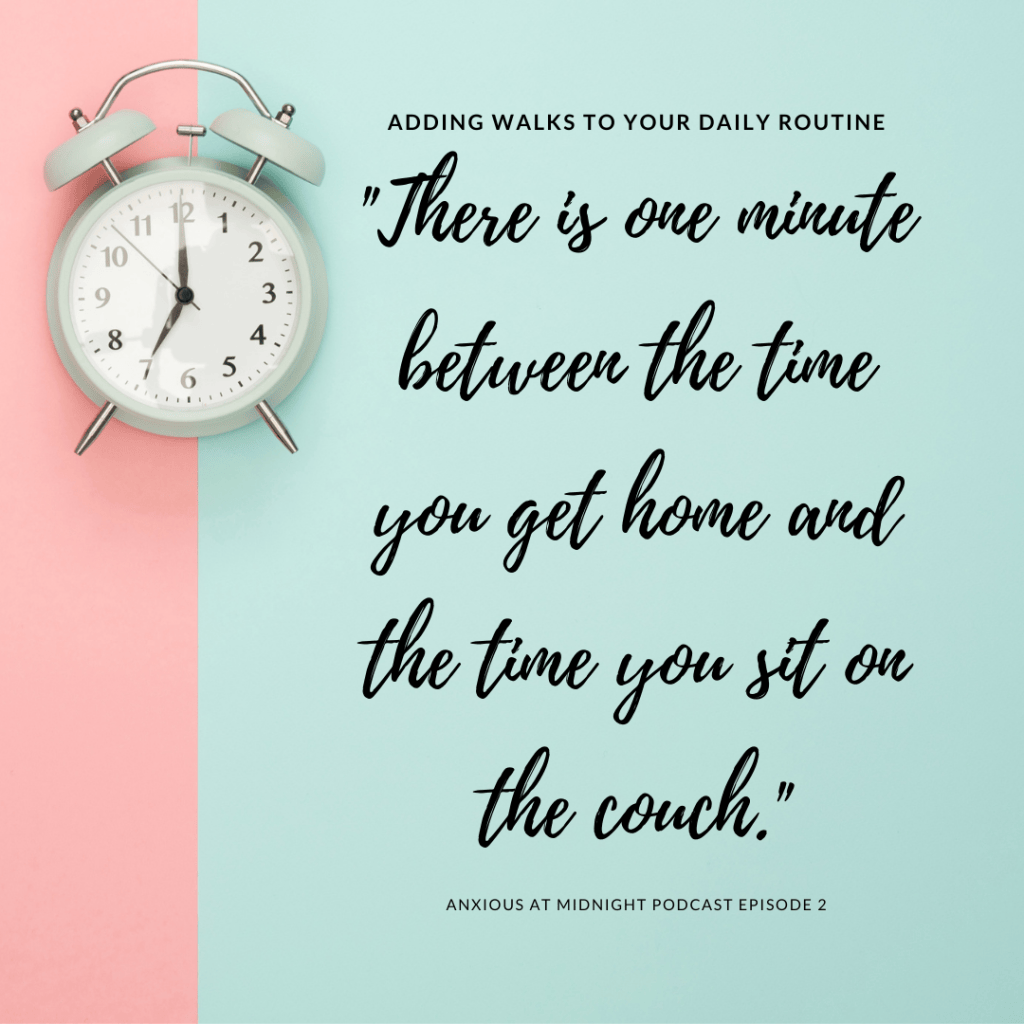
When you get home from work there is one minute in between the moment before you collapse on the couch. USE IT. Before you lose momentum, drop your bag and walk out the door. Change your shoes if you need, grab some water, do whatever you need to do in under one minute because you don’t want to lose momentum. I know it can be hard after getting home to do some walking, but if you just start with one minute of walking, you can anchor the habit of maintaining the momentum when you get home from work. Before you know it, you will be running out the door for a 45 minute walk.

Other quick tips:

  • Treat yo self and buy new shoes, new clothes and comfortable walking shoes. Just donโ€™t go crazy.
  • Get up 5 minutes earlierโ€ฆ 15 min earlier etcโ€ฆ 
  • Go outside
  • Find an exercise buddy
  • Schedule it
  • Sign up for a walking event
  • Count steps

Hope that helps! 


Post College Depression

As a college graduate of 2021, I have been feeling super strange since graduation after completing 7 years of college. So when looking at how to build up confidence for job searches, I came across post college depression. I did not know there was such a thing but it makes a lot of sense. 

I wanted to share with you all how it might feel coming out of college and how to adjust. Which seems to be somewhat applicable to those who have graduated high school or people who might be going back to work after being out of the game for some time. 

Post College Depression has very similar symptoms to clinical depression. I am here to let you know that the feelings of sadness, loneliness and anxiety after college are very common and you are not alone. It is normal to feel some degree of stuckness and discomfort. 

Possible Causes

When you are in college, you spend a lot of time picturing where you will be once you graduate in order to motivate yourself and oftentimes when we graduate our vision of post graduation doesnโ€™t match up with reality. This can especially be true for those who did not get to have an in person graduation, big graduation parties or an international backpacking trip in Europe due to COVID-19. 

Once you graduate, you may also be feeling a lot of pressure from yourself and others to continue succeeding. This is the very case for first generation students who may feel the burden to care for their families once they finish college. 

When you graduate you experience a million changes and that can include your social life. Maybe you have grown distant from your friends from freshman year and you finally have time to sit down and think about it. Maybe you are moving or your friends are moving and you feel depleted of a support system.

Symptoms

If you were a senior during the pandemic, you certainly have probably already been feeling this way. But here are some common symptoms people may experience as they move into the next chapter of their life:

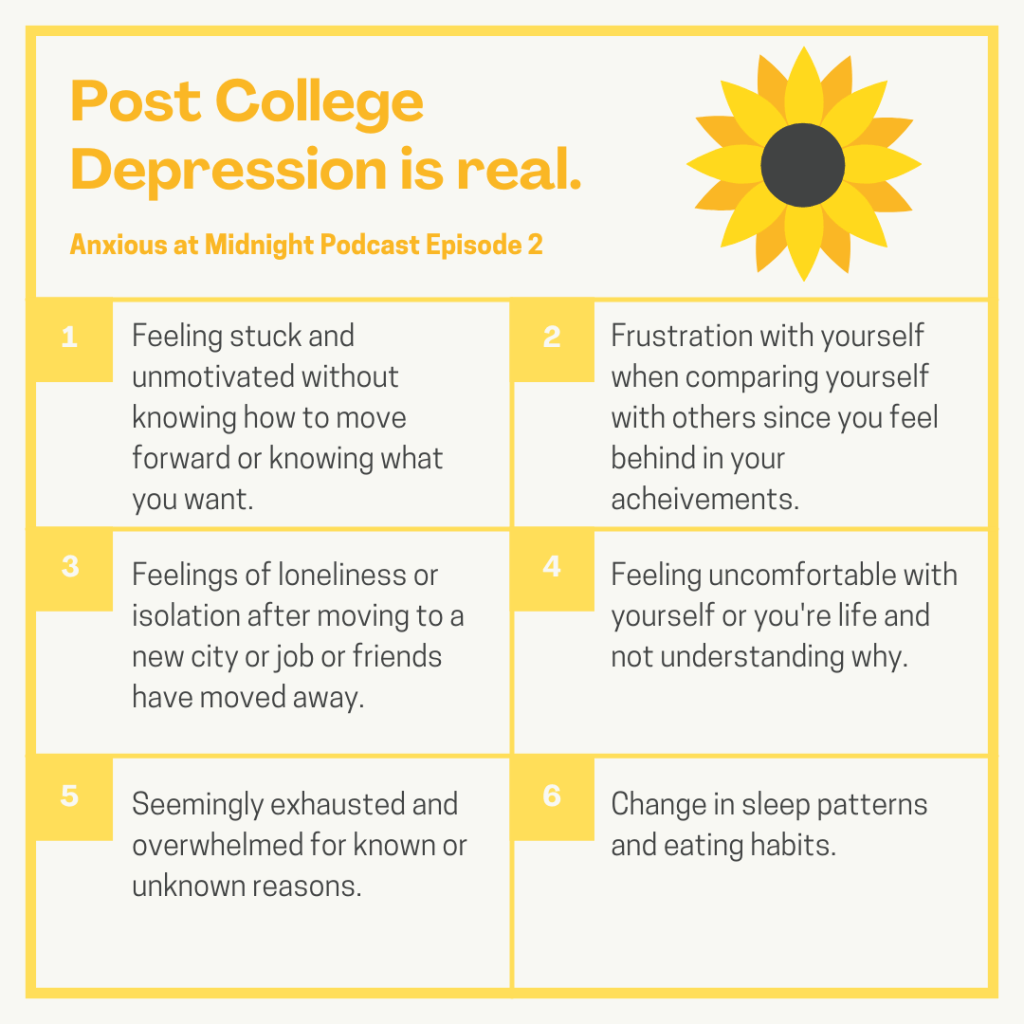
  • Uncomfortable with yourself or your life and you donโ€™t know why
  • Stuck or unmotivated, without knowing how to move forward or what you want to do
  • Unworthy, incapable as if you have disappointed yourself, friends or family
  • Isolated and unsupported in a new job, city or educational program
  • Lonely 
  • Sad
  • Loss in interest in things you used to love
  • Sense of disorganization
  • Sense of hopelessness
  • Angry at yourself because you have not achieved what you expected or at others because they created a barrier to your goals
  • Irritable or edgy
  • Emotions on a roller coaster
  • Exhausted and overwhelmed

Physical Symptoms

  • Trouble sleeping
  • Sudden bouts of tearfulness
  • Change in appetite
  • Change in sex drive
  • Headaches
  • Stomach problems
    • No appetite or nausea

Behavior Changes

  • Overuse technology and spend hours gaming, social media or scrolling
  • Exercise too much or too little
  • Overeat unhealthy foods
  • Consume too much alcohol, caffeine or use recreational drugs

Solutions

Luckily there are a lot of things you can do during this transition in your life. 

Accept your Feelings and Let Go of Guilt

Feelings of needing to get up and do something at all times can be a residual feeling after always being busy in college. But this may be a sign of needing to avoid your emotions. So it is important for you to take a break and practice mindfulness to listen to your feelings and what you are telling yourself. Healing will happen a lot faster once you accept how you feel and give your body and mind what it needs. 

Build Healthy Habits

To avoid feelings of exhaustion and sadness, exercise and nutritious food can put you in the right direction at the beginning of every day which will make you more productive and positive. 

Stay Connected

Make sure you are regularly speaking with your friends and family to feel supported and share what you are going through. This can be very therapeutic and your energy wonโ€™t be wasted on dwelling on unspoken thoughts. 

Make New Connections

You are in a new chapter of your life and now you have time for all your hobbies and things you have always wanted to learn. Dive in and take a class or join a club to meet new people and donโ€™t be afraid. 

Engage

Find things that are meaningful to you and dedicate some of your time and energy to these things so you can fulfil a sense of purpose. Starting with recognizing your values is a good place to start. 

Set Goals

Youโ€™ve probably heard of SMART goals a million times but setting achievable goals and making small steps toward accomplishment can make a big difference over time.


Disclaimer

This podcast includes explicit content, we discuss triggering material and are not mental health professionals. If you need immediate help please call the suicide hotline at 800-273-8255.

Sources

https://www.healthywomen.org/content/blog-entry/no-more-excuses-five-easy-ways-find-motivation-exercise

https://modernhealthmonk.com/the-habit-of-walking-regularly/

https://www.webmd.com/depression/features/post-college-depression

https://www.snhu.edu/about-us/newsroom/2020/01/post-graduate-depression

Episode 1: Anxious Panties

ADHD in the Workplace and Daily Exercise


Click the link above to listen to episode 1 which will cover coping with ADHD while working and fitting exercise into your daily routine!


ADHD in the Workplace

ADHD can affect you in the workplace, just like it affects you in school, the skills you need to thrive in the workplace are affected. You can end up losing a job, bouncing around, receiving bad performance reviews, etc. About 8 to 9 million American adults have ADHD and only half of those adults are able to hold down a full time job. Compare this to 72% of the population without ADHD who are able to hold down a job. 

Before we begin, it is important to remember that everyoneโ€™s situation is different and you need to consider your own unique circumstance. What works for you, may not work for someone else. With mental health there is no black and white, right and wrong. Adjust accordingly. 

You may find that your executive function abilities are affected in your performance at work. This includes:

  • Organization skills
  • Focus
  • Ability to sit through meetings
  • Project management/Case management
  • Trouble paying attention
  • Memory issues
  • Mental processing
  • Verbal fluency issues

Additionally, you may notice that the following is difficult for you:

  • Time management
  • Concentration 
  • Getting and staying organized
  • Following directions
  • Listening and paying attention
  • Completing assignments
  • Attention to details
  • Arriving on time
  • Poor communication skills
  • Speaking when it’s your turn
  • Sitting still
  • Management emotions
  • Procrastination 
  • Anger

I am sure you know the feeling when I say this shit ends up leading to depression and low self esteem. If you are not making deadlines, completing the work to your employerโ€™s satisfaction, the self doubt alone can ruin your shit. 

So we are here to tell you: You CAN keep a job!

First of all, if this all feels like youโ€ฆ go to the Doctor and get diagnosed. You want to make sure that you are able to be treated properly for your ADHD. The treatment plan includes medication and therapy. Therapy can come in many forms for ADHD. Some may see a therapist, an ADHD coach or even an occupational therapist. But practice is the key here! In order to improve your skills at anything, you need to practice. 

When you are looking for a job, make sure that you find something that matches your interests, needs and abilities. Maybe more fast-paced with flexible hours, more stimulating, etc. Believe it or not, ADHD can actually be beneficial in starting your own business.

Regardless of where you are, there are great ways to help out with ADHD. 

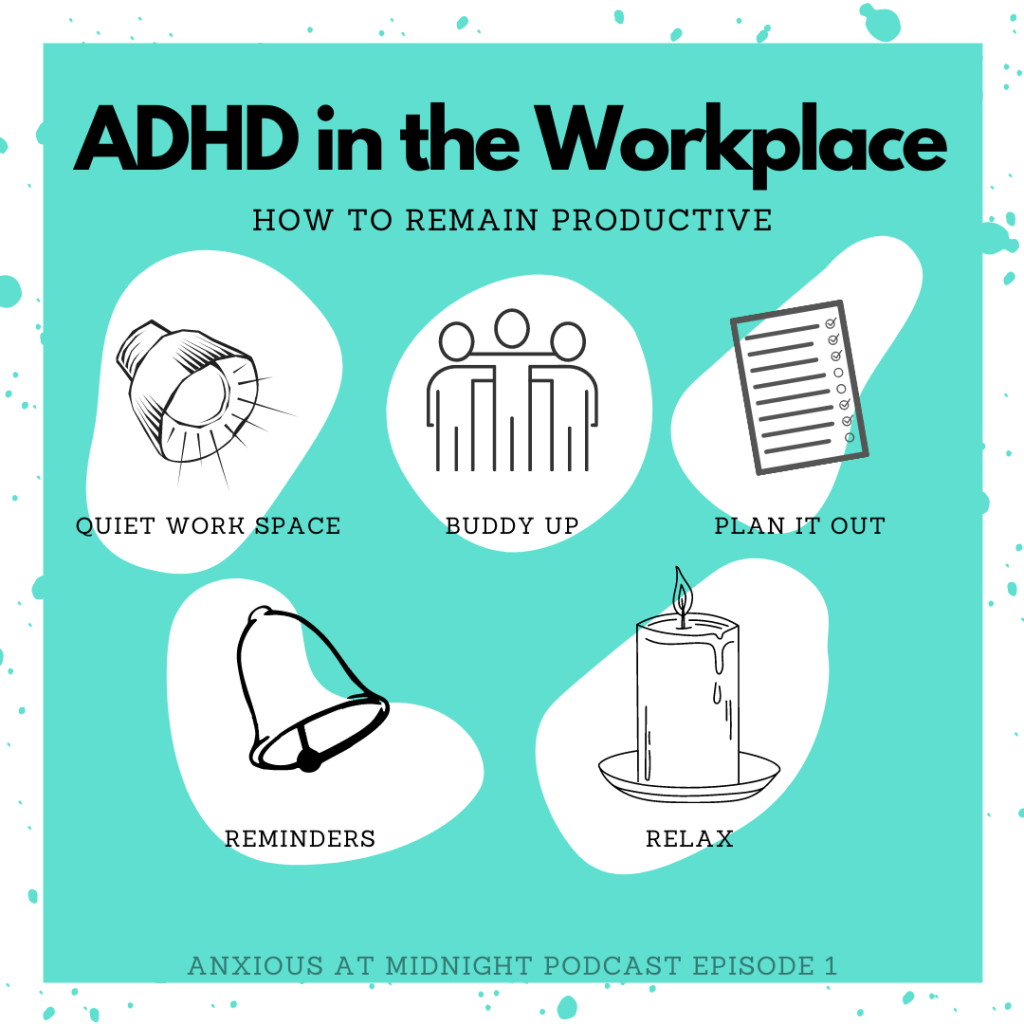
Quiet Work Space

A quiet work space will promote a distraction free environmentโ€ฆ. If you set it up properly! Having a private work space is ideal or even working from home if you are lucky enough. If not, maybe you can work in an unused space where you can focus. While working, send your phone calls to voicemail and mute your notifications. Keep a notepad to write down ideas, thoughts and to dos. White noise is great for drowning out distractions around you that you cannot control.

Buddy Up

Find someone that you can buddy up with at work. Maybe this person has similar work to you, or you get along well with them. It is especially a good idea to have a mentor. 

Time Management

If only this was an easy topic. We can try to sum it up the best we can. Timeline charts may be helpful in breaking up a project into smaller pieces and steps. Also, if you are like Fionna, you are visual! Colors and pictures are a visual learning dream. Consider having a system of rewards. This doesn’t necessarily have to be monetary. You could play some video games after 30 minutes of work, or take a walk outside (yikes). Setting alarms will help keep you on track. You may even want to set multiple reminders. One of the most important pieces is to overestimate the time it will take you to get a task done, that way you avoid overscheduling yourself.

Reminders

Memory sucks when you have ADHD. Get creative and find ways to remind yourself of things that need to be done. There are several ways you can start doing this. You can use a day planner, calendar (multiple calendars), use a task tracker, bulletin board, smart phone, to do lists, etc. We personally love bullet journalingโ€ฆ. but more on that later. You may even consider a tape recorder. Whatever you do, make sure to writeโ€ฆ. thatโ€ฆ. shitโ€ฆ. down. Seriously. Notes, stickies, word documents, etc. This can actually aid in being a hyperactivity buster too! 

Plan Your Shit

Make sure you schedule a time for your emails, calls and meetings. Set realistic goals by using SMART goals. More on that later. Break up your assignment or task into smaller chunks, find yourself an accountability partner, ask for deadlines and expectations, work in a team or ask someone for guidance. 

Treat Yo’ Self

If you think about life, there is a reward for everything. We work to get paid, we take care of our health to hopefully live older, etc. Some ideas of rewards are taking a walk, reading a magazine, etc. When you have big goals, maybe you can buy yourself a special lunch. Important note: moving helps the hyperactivity, if sedentary then you can add more movement with walking or dancing to make copies. 

Delegate

Delegate what you can, maybe an assistant or intern can help you. 

Relax

In the day to day I think we often forget that relaxation techniques really can do wonders for us. It helps us avoid impulsivity, anticipate problems that trigger impulsive behaviors, develop a routine, ask for feedback, etc. 

To disclose or not to disclose.. that is the very important questionโ€ฆ It is suggested not to tell your work place if you do not need accommodations, you are performing well or if you feel like there may be a discrimination issue. Although, that is a shitty ass reason not to. Do tell if you fear that you may lose your job because you do not have accommodation or are about to be fired. 

It is difficult to live with ADHD and it does take a lot of work to function in a way that we are expected to. However, there are a few positives. This is a disability, technically your work must give you accommodations and not discriminate. ADHD comes with a lot of benefits: relentlessness and impulsive desires to try new shit are the best ones! Use your creativity, energy and strength and slay that bitch.


Daily Exercise

Including exercise into your routine is a common struggle in this day in age. It always seems like there is never enough time. But I am here to remind you of the importance of exercise, the endless benefits and integrating into your busy schedule.

One of the biggest reasons people exercise daily is to control their weight. This can be to gain weight, lose weight, or maintain weight. But there are many more reasons to continue exercising throughout your lifetime. Here are some of the benefits:

  • Reduce risk of heart disease
  • Help your body manage blood sugar and insulin levels
  • Help you quit smoking
  • Keep your thinking, learning and judging sharp
  • Help memory
  • Strengthen bones and muscles
  • Reduce risk of sme cancers
  • Reduce risks of falls
  • Improve your sleep
  • Improve your sexual health
  • Increase your chance of living longer
  • Increase energy levels
  • Help skin health
  • Help chronic pain
  • Can be fun and social
  • Improve self confidence
  • Enjoy the outdoors
  • Get more done
  • Increase creativity

But one of the greatest reasons we recommend our listeners to exercise is to improve your mental health and mood. Daily exercise can have all of these benefits and contribute to improving your mental health. Exercise reduces the risk of depression and helps reduce stress and anxiety. Majority of the challenges we encounter every day can be improved with daily exercise.

Exercise does not need to occur daily to reap the benefits but it is recommended that one exercises daily in order to maintain the habit. Additionally, it may seem easier to exercise every day for 20 minutes rather than a whole hour. The CDC recommends that people have at least 150 minutes of moderate aerobic activity or 75 minutes of vigorous aerobic activity. 20 minutes of moderate aerobic activity on a daily basis can get you to 150 minutes per week. And in turn you will reap the benefits listed above.

Here are some tips to incorporate exercise into your life daily:

  • Piece it together throughout the day
  • Exercise with a friend
  • Use a smart watch and/or reminders
  • Turn off the TV/phone/videogames/computer/etc to get yourself moving
  • Do workouts while watching/listening to TV/podcasts/music/etc
  • Sign up for a class
  • Plan it into your schedule
  • Reward yourself
  • Start small
  • Lay out your gear
  • Get out the door
  • Mix it up, make it fun
  • Get a rest day in when needed
  • Remove obstacles

Speak to your physician to get a better idea of your bodyโ€™s needs. Make sure to stretch, warm up, drink water and cool down. Do not forget to listen to your body!


Disclaimer

This podcast includes explicit content, we discuss triggering material and are not mental health professionals. If you need immediate help please call the suicide hotline at 800-273-8255.

Sources

https://www.webmd.com/add-adhd/adhd-in-the-workplace

https://chadd.org/for-adults/workplace-issues/

https://adhdatwork.add.org/impact-of-adhd-at-work/

https://medlineplus.gov/benefitsofexercise.html

https://www.healthline.com/nutrition/10-benefits-of-exercise#TOC_TITLE_HDR_2

https://www.mayoclinic.org/healthy-lifestyle/fitness/in-depth/exercise/art-20048389

https://www.cdc.gov/physicalactivity/basics/pa-health/index.htm

https://greatist.com/fitness/13-awesome-mental-health-benefits-exercise#tl-dr

https://www.hsph.harvard.edu/nutritionsource/2013/11/04/making-exercise-a-daily-habit-10-tips/

https://zenhabits.net/how-to-make-exercise-a-daily-habit-with-a-may-challenge/

https://www.helpguide.org/articles/healthy-living/how-to-start-exercising-and-stick-to-it.htm#